

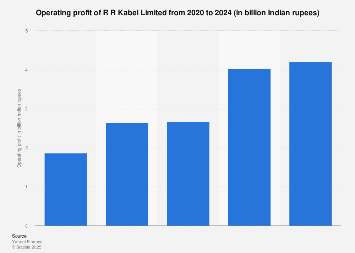
While precise, granular figures for R R Kabel Limited’s operating profit in 2024 are not publicly disclosed in a readily accessible format, the company’s performance is intrinsically linked to the robust expansion of India’s infrastructure sector, a key driver for the electrical and power cable industry. Industry analysts and market observers closely monitor the company’s financial health, particularly its operating profit margin, as a critical indicator of its operational efficiency and its ability to capitalize on the surging demand for its products. The operating profit, representing earnings before interest, taxes, depreciation, and amortization (EBITDA), provides a clear picture of the company’s core business profitability, stripping away financing and accounting decisions.
The Indian cable market, a significant segment within the broader electrical industry, is experiencing a period of sustained growth. This expansion is fueled by a confluence of factors including substantial government investment in power generation and transmission infrastructure, the rapid urbanization of the country leading to increased demand for residential and commercial wiring, and the burgeoning renewable energy sector which requires extensive cabling solutions. Government initiatives like "Power for All" and the push for smart grid development further underpin this demand. Projections from various market research firms indicate that the Indian cables and wires market is poised for significant growth in the coming years, with Compound Annual Growth Rates (CAGRs) often estimated in the high single digits or even low double digits, depending on the specific sub-segment and forecast period.
Within this dynamic landscape, R R Kabel Limited, as a prominent player, is strategically positioned to benefit. The company’s product portfolio, which typically includes a wide range of power cables, control cables, instrumentation cables, and building wires, caters to diverse applications across the power, industrial, and infrastructure sectors. Its operating profit is therefore a direct reflection of its sales volume, pricing power, and its ability to manage its cost of goods sold and operational expenses effectively. Fluctuations in raw material prices, particularly copper and aluminum, which are key inputs for cable manufacturing, can significantly impact operating profit margins. Companies like R R Kabel often employ hedging strategies and long-term supply contracts to mitigate these price volatilities.
Examining the broader Indian electrical industry, we observe a trend of consolidation and increasing competition. However, established players with strong brand recognition, extensive distribution networks, and a commitment to quality and innovation, like R R Kabel, tend to maintain a competitive edge. The company’s ability to adapt to evolving technological demands, such as the increasing need for specialized cables for high-voltage direct current (HVDC) transmission or data center applications, will also be crucial for sustaining and enhancing its operating profit.
Globally, the electrical cable market is characterized by innovation and sustainability. There is a growing emphasis on energy-efficient cables, fire-retardant materials, and cables designed for harsh environmental conditions. Companies that invest in research and development to offer such advanced solutions are better positioned to capture premium pricing and expand their market share. While specific R R Kabel R&D expenditures are not detailed here, their sustained presence in the market suggests a commitment to product development.
The operating profit of a company like R R Kabel is also influenced by macroeconomic factors. India’s overall economic growth rate, inflation levels, interest rate environment, and foreign exchange rates can all have a ripple effect on the company’s performance. For instance, a depreciating Rupee can increase the cost of imported raw materials, potentially squeezing margins, while a robust economy generally translates to higher demand for infrastructure and construction, boosting sales.
Furthermore, regulatory frameworks and environmental standards play an increasingly important role. Compliance with safety regulations, quality certifications, and emerging sustainability mandates can add to operational costs but also create opportunities for companies that meet these requirements. The global push towards decarbonization and renewable energy sources is a significant long-term trend that R R Kabel, like other cable manufacturers, needs to address through its product offerings and manufacturing processes.
While precise 2024 operating profit figures for R R Kabel Limited require access to proprietary financial data, the company’s performance can be inferred from its market position, the growth trajectory of the Indian electrical and infrastructure sectors, and the prevailing industry dynamics. Investors and industry analysts will continue to scrutinize key financial metrics, including operating profit, to gauge the company’s financial health and its prospects in a rapidly evolving economic and industrial landscape. The company’s strategic decisions regarding capacity expansion, technological adoption, and market penetration will be critical determinants of its future profitability and its standing within the global cable manufacturing industry. The consistent growth of the Indian economy, coupled with targeted government spending on infrastructure, provides a fertile ground for companies like R R Kabel to not only maintain but also potentially enhance their operating profit in the coming fiscal years.