
The digital asset market faced a significant reckoning this week as Bitcoin plummeted to its lowest valuation since the initial volatility sparked by the 2025 tariff announcements. This downward trajectory marks a stark departure from the record-breaking rallies seen earlier in the year, highlighting the sensitivity of the cryptocurrency sector to shifting trade policies and the resultant fluctuations in the foreign exchange markets. As investors grapple with the implications of a protectionist trade environment, the "digital gold" narrative is being tested against the harsh reality of a surging U.S. dollar and a fundamental repricing of global risk.
The catalyst for this latest retreat is inextricably linked to the broader macroeconomic fallout from newly implemented trade barriers. When the administration first signaled a move toward aggressive tariffs on major trading partners—specifically targeting imports from China, Mexico, and Canada—the immediate reaction across financial markets was a flight to quality. While Bitcoin has often been championed as a hedge against fiat currency debasement, its recent performance suggests it remains firmly tethered to the "risk-on" appetite of institutional investors. As trade tensions escalate, the resulting uncertainty has prompted a massive deleveraging event, with traders exiting speculative positions in favor of the liquidity and perceived safety of the greenback.
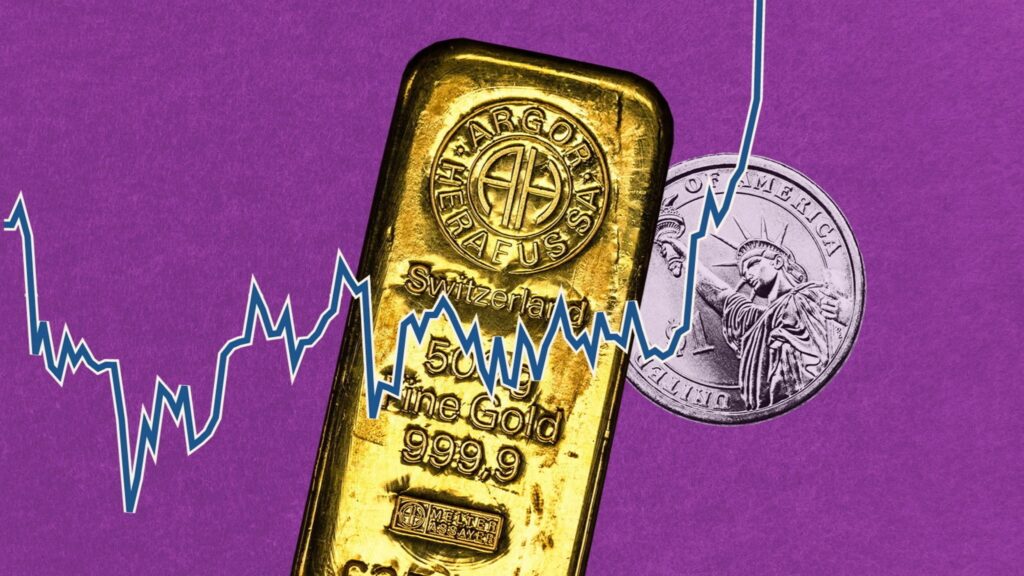
Central to this price action is the resurgence of the U.S. Dollar Index (DXY). Historically, Bitcoin has maintained a strong inverse correlation with the dollar. As tariffs threaten to increase the cost of imported goods, inflationary pressures are expected to persist, potentially forcing the Federal Reserve to maintain a restrictive monetary stance for longer than previously anticipated. This "higher-for-longer" interest rate environment makes non-yielding assets like Bitcoin less attractive compared to U.S. Treasuries, which are seeing yields climb in anticipation of a more hawkish central bank. The strength of the dollar has effectively acted as a ceiling for digital asset prices, stifling the momentum that had briefly carried Bitcoin toward the psychological milestone of $100,000.
The impact on the spot Bitcoin Exchange-Traded Fund (ETF) ecosystem has been equally pronounced. After months of record-breaking inflows that defined the first half of the year, the sentiment among institutional allocators appears to have shifted toward caution. Data from major fund providers indicates a cooling of demand, with several consecutive days of net outflows totaling hundreds of millions of dollars. For many institutional players, the volatility introduced by the 2025 tariff shock has necessitated a re-evaluation of portfolio weightings. The rapid institutionalization of the asset class means that Bitcoin is no longer insulated from the tremors of the traditional financial system; instead, it has become a high-beta proxy for global economic sentiment.
Market analysts point to the specific mechanics of the tariff shock as a primary driver of the current slump. Unlike traditional inflationary periods driven by excessive monetary stimulus, the current inflationary threat is supply-side driven. Tariffs act as a tax on domestic consumers and a friction point for global supply chains. In such an environment, corporate profit margins are squeezed, and discretionary capital—the lifeblood of the crypto market—begins to dry up. Experts suggest that the market is currently pricing in a "stagflationary" scenario where growth slows due to trade friction while prices remain elevated, a combination that historically punishes speculative growth assets.
The technical landscape for Bitcoin has also deteriorated alongside the fundamental backdrop. After failing to maintain support at the $95,000 level, the digital currency broke through several key moving averages, triggering automated sell orders and liquidating long positions in the derivatives market. This cascading effect exacerbated the price drop, leading to a "flash" correction that wiped out billions in market capitalization within a single trading session. Analysts are now closely watching the $85,000 and $82,000 support zones, noting that a failure to hold these levels could invite a deeper retracement toward the $75,000 range, effectively erasing the gains seen during the post-election "Trump trade" rally.
From a global perspective, the reaction to the tariff-induced Bitcoin slump has been varied. In regions where local currencies are devaluing rapidly against the dollar, such as parts of Latin America and Southeast Asia, the demand for Bitcoin remains relatively stable in local currency terms. However, in the major liquidity hubs of New York, London, and Hong Kong, the narrative is dominated by the "dollar-crush" effect. European markets, already struggling with stagnant growth, have seen a similar retreat in crypto-related equities and investment products as the Euro weakens against the greenback, making dollar-denominated assets like Bitcoin more expensive for international buyers.
The role of the mining industry also cannot be overlooked in this context. Bitcoin miners, who operate on thin margins and are highly sensitive to energy costs and hardware pricing, are facing a double-edged sword. While the price of Bitcoin is falling, the cost of imported mining equipment—much of which is manufactured in regions targeted by the new tariffs—is expected to rise. This potential increase in capital expenditure, combined with reduced revenue from block rewards, could lead to a period of "miner capitulation," where smaller operations are forced to sell their holdings to stay afloat, adding further sell pressure to the market.
Despite the prevailing gloom, some proponents of the digital asset space argue that the current correction is a necessary "cleansing" of the market. They contend that the volatility sparked by the tariff shock serves to shake out "weak hands" and speculative leverage, leaving a more robust foundation for the next leg of the cycle. These observers point to the underlying growth in network activity and the continued development of Layer-2 scaling solutions as evidence that the long-term value proposition of the blockchain remains intact. However, in the immediate term, the "macro-over-micro" theme is expected to persist, with Bitcoin remaining a hostage to the headlines coming out of the Department of Commerce and the Office of the U.S. Trade Representative.
The broader cryptocurrency market has not been spared from the contagion. Ethereum, the second-largest digital asset by market cap, has seen even steeper percentage declines, struggling to find its footing as investors prioritize Bitcoin’s perceived "relative safety" within the crypto ecosystem. Smaller "altcoins" have faced a liquidity vacuum, with many dropping 20% to 30% from their recent peaks. This "flight to quality" within the crypto space suggests that even the most ardent digital asset enthusiasts are becoming more discerning in an era of geopolitical instability.
Looking ahead, the trajectory of Bitcoin will likely depend on the clarity—or lack thereof—regarding future trade negotiations. If the 2025 tariffs are seen as a permanent fixture of the economic landscape rather than a temporary negotiating tactic, the "risk premium" associated with Bitcoin may need to be permanently adjusted. Conversely, any signs of a de-escalation in trade tensions or a pivot by the Federal Reserve toward a more accommodative policy could provide the spark needed for a recovery.
For now, the market remains in a "wait-and-see" mode. The 2025 tariff shock has served as a potent reminder that Bitcoin, for all its revolutionary potential, does not exist in a vacuum. It is a part of a complex, interconnected global financial system that is currently undergoing its most significant structural shift in decades. As the dust settles on this latest price slide, the primary question for investors is whether Bitcoin will eventually decouple from the dollar and trade as a true sovereign asset, or whether it will remain a barometer for the very global trade order that is currently being dismantled. Until that question is answered, the path of least resistance for the digital asset market appears to be one of heightened volatility and cautious re-entry.