

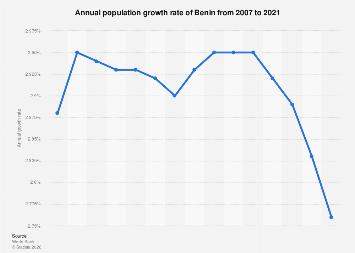
Benin, a West African nation situated on the Gulf of Guinea, experienced a significant demographic expansion between 2007 and 2021, a period marked by consistent population growth that has reshaped its socio-economic landscape. While specific figures for annual growth rates are often subject to detailed statistical analysis, the overarching trend points to a country grappling with and benefiting from an increasingly youthful and expanding populace. This sustained increase is not merely a statistic; it represents a dynamic force with profound implications for governance, resource allocation, labor markets, and long-term development strategies.
The period under review, 2007 to 2021, covers a span where Benin, like many developing economies, navigated global economic shifts, political transitions, and evolving developmental priorities. During these years, the nation’s population trajectory was characterized by a robust birth rate and a gradual decline in mortality rates, factors commonly associated with demographic transition phases. This sustained growth means that the number of individuals residing within Benin’s borders has steadily climbed, placing increasing demands on public services and infrastructure while simultaneously presenting opportunities for economic expansion through a larger workforce and consumer base.
Understanding the nuances of this population growth requires examining key demographic indicators. While precise year-on-year figures are often proprietary, broader trends indicate that Benin’s population has been on an upward climb, likely mirroring regional patterns where high fertility rates, though potentially declining, continue to outpace mortality. This demographic dividend, if harnessed effectively, can fuel economic growth. However, it also necessitates substantial investment in education, healthcare, and job creation to prevent the emergence of significant social and economic challenges.
The economic implications of such demographic trends are multifaceted. A growing population, particularly one with a significant youth bulge, implies a larger potential labor force. For Benin, this presents an opportunity to capitalize on a demographic dividend, provided there are sufficient employment opportunities to absorb new entrants into the job market. The informal sector, which is substantial in many West African economies, often absorbs a significant portion of this growing workforce, offering livelihoods but also posing challenges related to worker protection, productivity, and tax revenue.
Conversely, rapid population growth can strain existing infrastructure and public services. The demand for housing, clean water, sanitation, healthcare facilities, and educational institutions escalates. If investment in these areas does not keep pace with population expansion, it can lead to reduced quality of life, increased social inequalities, and hinder overall development progress. Benin’s government faces the perennial challenge of balancing the immediate needs of a growing population with long-term developmental investments.
International comparisons offer valuable context. Many sub-Saharan African nations are experiencing similar demographic patterns, with high population growth rates influencing their economic development strategies. Countries that have successfully managed their demographic transitions have often done so through concerted efforts in family planning, female empowerment, and investing heavily in human capital development. Benin’s approach to managing its population growth and leveraging its demographic potential will be critical in determining its future economic prosperity and social stability.
Statistics on fertility rates, life expectancy, and urbanization provide further insights. While specific data for Benin from 2007-2021 would reveal precise figures, general trends in the region suggest a continued high total fertility rate, though potentially on a downward slope. Life expectancy has likely seen incremental improvements, contributing to population growth. Urbanization, a global phenomenon, is also a significant factor, with more people migrating to cities in search of economic opportunities, placing additional pressure on urban infrastructure and services.
The economic impact analysis of Benin’s population growth can be viewed through several lenses. On the demand side, a larger population means a greater consumer market, which can stimulate domestic production and attract investment. However, the purchasing power of this larger population is a crucial determinant of the extent of this stimulus. If a significant portion of the population remains in low-income brackets, the aggregate demand may not translate into robust economic growth.
On the supply side, the expanding labor force is a key asset. The challenge lies in ensuring this labor force is skilled and productive. Investment in vocational training, higher education, and entrepreneurship programs is paramount. Moreover, creating an enabling business environment that encourages job creation, particularly in sectors with high growth potential like agriculture, manufacturing, and services, is essential to harness the demographic dividend effectively.
The role of remittances and foreign direct investment (FDI) also plays a part in the economic equation. Remittances from Beninese citizens working abroad can provide a crucial source of income and support for families, influencing household consumption. FDI can bring capital, technology, and expertise, contributing to job creation and economic diversification. The extent to which Benin’s growing population influences these flows, both as a source of labor and as a consumer market, is a dynamic interplay.
Looking at the broader economic landscape, Benin’s growth has been influenced by factors such as its reliance on agriculture, its strategic location as a trading hub, and government policies aimed at economic diversification and poverty reduction. Population growth intersects with these factors, demanding that agricultural productivity increase to feed more mouths, that trade infrastructure be enhanced to serve a larger market, and that economic reforms are sufficiently robust to create opportunities for the growing populace.
The period from 2007 to 2021 also saw Benin making efforts to strengthen its democratic institutions and improve its governance. Effective governance is crucial for managing demographic change. This includes implementing sound population policies, investing in human capital, ensuring equitable distribution of resources, and fostering a stable environment conducive to economic activity. The ability of the government to plan and execute policies that address the needs of a growing population directly impacts the nation’s development trajectory.
In conclusion, Benin’s demographic evolution between 2007 and 2021 is a central narrative in its economic and social development story. The sustained population increase presents both significant opportunities and formidable challenges. Effectively navigating this demographic shift requires a comprehensive and proactive approach, focusing on human capital development, robust job creation, sustainable resource management, and responsive governance. The nation’s ability to transform its growing population into a demographic dividend, rather than a burden, will be a defining factor in its progress in the coming decades.