

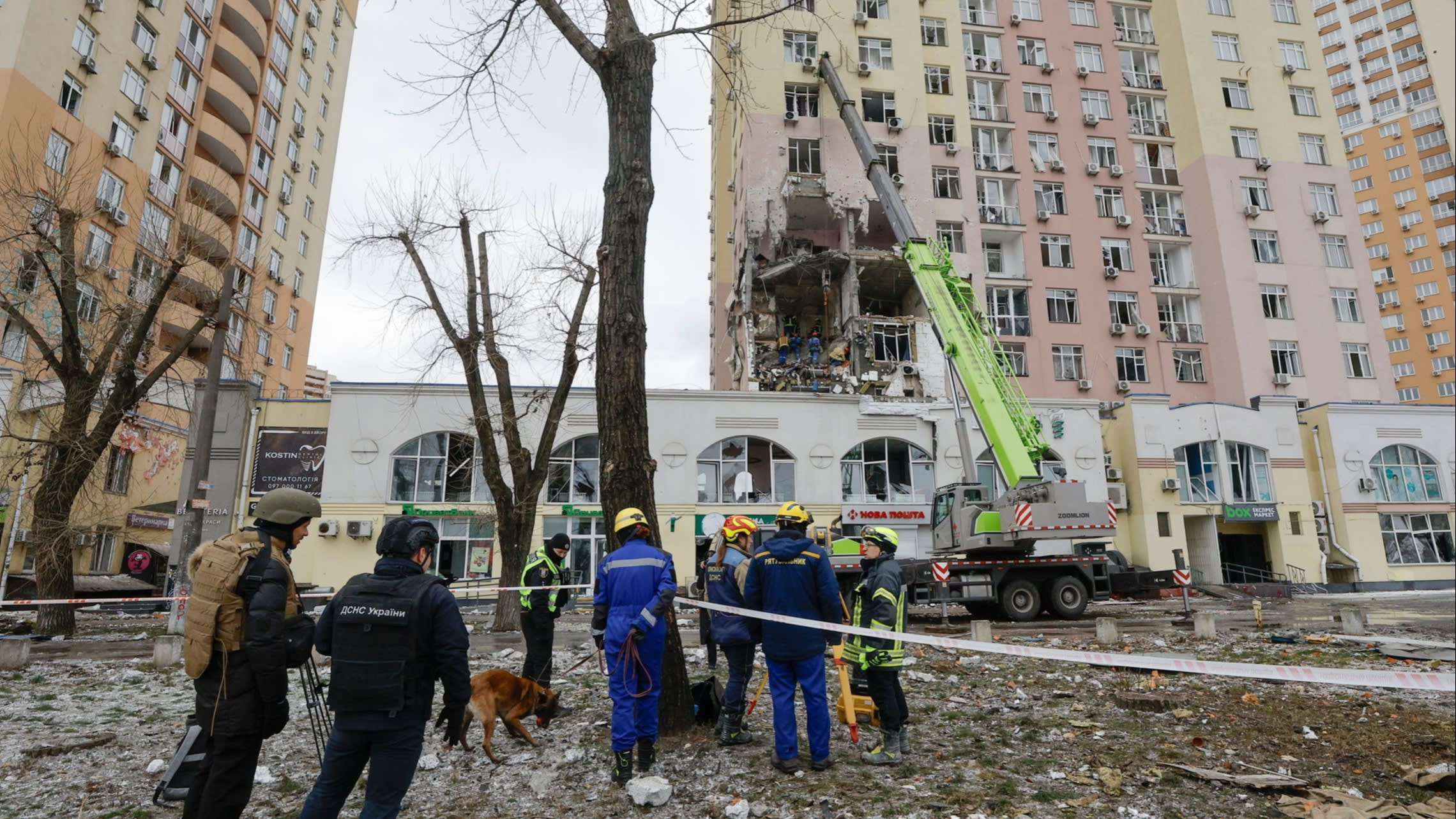
The sirens that echoed through the streets of Kyiv in the early hours of Wednesday were not merely a reminder of the persistent kinetic threat from the East, but a somber overture to one of the most consequential diplomatic weeks in Ukraine’s modern history. As Russian forces launched a multi-pronged aerial assault involving ballistic missiles and a swarm of loitering munitions, President Volodymyr Zelenskyy prepared to depart for a high-stakes encounter in the United States. This meeting, specifically with former President and current Republican frontrunner Donald Trump, represents a pivotal moment for the future of transatlantic security architecture and the continued viability of Ukraine’s defense against Russian aggression.
The latest barrage on the Ukrainian capital serves as a tactical manifestation of Moscow’s broader strategy: to degrade the nation’s infrastructure and morale simultaneously while testing the limits of Western-supplied air defense systems. According to military analysts, the timing of these strikes is rarely coincidental. By intensifying the pressure on Kyiv just as Zelenskyy seeks to solidify long-term military and financial commitments from his most significant benefactor, the Kremlin is signaling its resolve to continue a war of attrition that many fear could stretch deep into the next decade.
The economic toll of these persistent strikes is staggering. The World Bank and the European Commission have recently updated their estimates for the recovery and reconstruction of Ukraine, placing the figure at upwards of $486 billion. Every missile that penetrates the defense shield around Kyiv or other major hubs like Kharkiv and Odesa adds millions to this tally, targeting not just military installations but critical energy nodes, transport networks, and industrial centers. For international investors and the global insurance market, the continued volatility in Ukrainian airspace remains the primary deterrent to the private capital inflows necessary for the country’s eventual economic rebirth.
Against this backdrop of smoke and debris, the diplomatic theater in Washington takes on an existential quality. The relationship between Zelenskyy and Trump has historically been fraught, characterized by the 2019 phone call that led to the first impeachment of the American president. However, the current geopolitical reality necessitates a pragmatic, if uncomfortable, rapprochement. Trump has repeatedly claimed that he could resolve the conflict within "24 hours" if re-elected, a statement that has caused significant anxiety in Kyiv and among European allies who fear a settlement might involve significant territorial concessions and a compromise of Ukrainian sovereignty.
From a business and economic perspective, the shift in the American political winds is already impacting global markets. Defense contractors in the United States and Europe, including giants like Lockheed Martin, Rheinmetall, and BAE Systems, are closely monitoring the rhetoric coming out of the Trump campaign. A pivot toward a more isolationist "America First" policy could disrupt the multi-billion-dollar pipelines of military aid that have sustained the Ukrainian front lines. Conversely, some analysts suggest that a Trump administration might favor a "Lend-Lease" style model—converting aid into loans—which would fundamentally alter Ukraine’s sovereign debt profile and long-term fiscal sustainability.
The European Union, cognizant of the potential for a vacuum in American leadership, has been scrambling to "Trump-proof" its support for Kyiv. The recent approval of the Ukraine Facility, a €50 billion multi-year financial assistance package, was a critical step in providing fiscal predictability. However, Europe’s defense industrial base remains fragmented and lacks the immediate capacity to replace the sheer volume of artillery shells and interceptor missiles currently provided by the United States. This industrial bottleneck is a primary concern for Brussels, as it seeks to move from a "crisis management" mode to a sustainable, long-term defense posture.
Russia’s own economic situation provides a stark contrast. Despite being the most sanctioned nation on Earth, the Russian economy has shown a degree of resilience that has surprised many Western economists. By pivoting its energy exports toward China and India and adopting a "war economy" footing, the Kremlin has managed to sustain a defense budget that now consumes roughly 6% of its GDP. This mobilization of resources allows Moscow to produce or refurbish an estimated 125 tanks per month and millions of artillery rounds, creating a quantitative challenge that Ukraine can only offset with superior Western technology and intelligence.
The impact of the ongoing conflict extends far beyond the borders of Eastern Europe, influencing global commodities and food security. Ukraine remains a "breadbasket" for the world, and any escalation that threatens the Black Sea shipping lanes or the Danube river ports has an immediate effect on wheat and corn futures in Chicago and London. The uncertainty surrounding the war’s duration and the potential for a negotiated settlement under a new U.S. administration has kept market volatility high. For emerging economies in the Global South, which rely on affordable grain imports, the outcome of Zelenskyy’s diplomatic mission is as much about food prices as it is about geopolitical principles.
In the corridors of power in Kyiv, there is a growing realization that the "Victory Plan" Zelenskyy intends to present in Washington must be more than a request for more hardware. It must be a comprehensive economic and security roadmap that appeals to both sides of the American political aisle. For the Democratic establishment, it is a matter of defending the liberal international order. For the Republican wing skeptical of foreign entanglements, the argument must shift toward the strategic necessity of degrading a primary adversary’s military capability without the involvement of American boots on the ground—a "return on investment" logic that fits the transactional nature of modern populist politics.
Expert insights suggest that the meeting with Trump will likely focus on the mechanics of a potential peace process. Sources close to the Ukrainian administration indicate that Zelenskyy is prepared to discuss "security guarantees" that do not necessarily involve immediate NATO membership—a red line for Moscow—but rather a series of bilateral "porcupine" defense agreements designed to make a future Russian invasion prohibitively expensive. This middle-path approach is seen as a way to bridge the gap between the current administration’s "as long as it takes" mantra and the "end the war now" rhetoric of the opposition.
The human and social costs, however, remain the most difficult to quantify. The "brain drain" from Ukraine, as millions of its most educated and productive citizens remain abroad, poses a long-term demographic threat that no amount of military aid can easily fix. For the business community, the return of this diaspora is contingent upon a durable peace, not just a frozen conflict. The fear is that a rushed peace deal, brokered in Washington without sufficient safeguards, would merely provide Russia with a "breather" to rearm and strike again in three to five years, effectively making Ukraine uninvestable for a generation.
As the smoke cleared from the morning’s attacks in Kyiv, the resilience of the local population remained on full display. Power was restored to affected districts within hours, and the city’s metro system—which doubles as a bomb shelter—returned to its role as a bustling transit hub. This stoicism is Ukraine’s greatest asset, but it is not an infinite resource. The economic pressure of a prolonged war of attrition is designed to crack this resolve, making the diplomatic maneuvers in Washington a race against time.
The forthcoming discussions between Zelenskyy and the American political leadership will likely dictate the trajectory of the global economy for the mid-2020s. Whether the result is a renewed commitment to a sovereign Ukraine or the beginning of a messy, forced partition, the consequences will ripple through the halls of the United Nations, the trading floors of Wall Street, and the energy markets of the Middle East. For now, the world watches as a nation under fire attempts to navigate the treacherous waters of domestic American politics, knowing that the cost of failure is measured not just in dollars and euros, but in the very maps of the European continent.