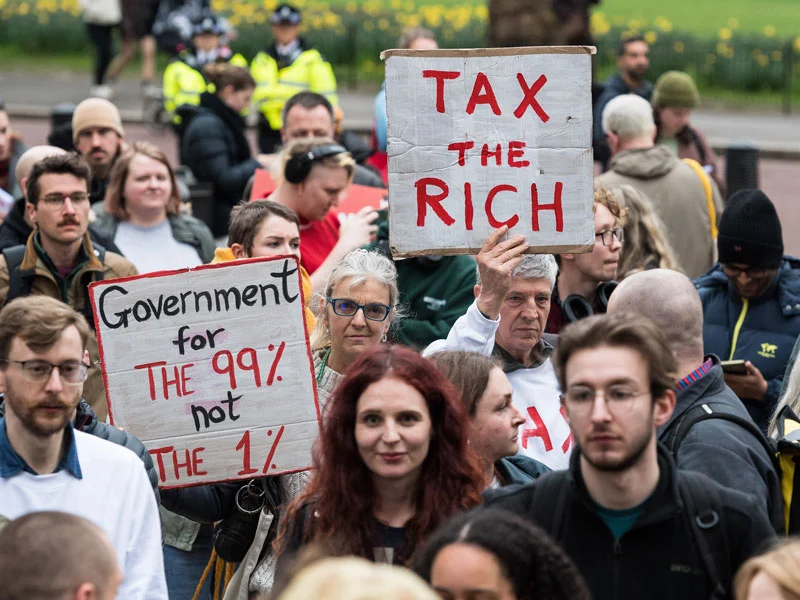
Gary Stevenson, a former high-flying financial trader turned social economist, is not afraid to challenge the status quo. His prominent platform, amplified through his widely-watched YouTube channel "Gary’s Economics" and appearances on influential podcasts like "Diary of a CEO," has become a powerful engine for advocating a radical shift in economic policy: a wealth tax on fortunes exceeding £10 million. Stevenson, who openly acknowledges his own millionaire status, argues passionately that such a measure is not merely desirable but essential for the economic health and social justice of Western nations, particularly the UK, which he believes is on the brink of collapse.
His recent appearance on a special edition of "Diary of a CEO," alongside serial entrepreneur Daniel Priestley, underscored the complex and often fraught nature of discussing economic inequality. The two-and-a-half-hour conversation, while at times heated, was notable for its intellectual rigor and mutual respect. Both men presented well-researched arguments, demonstrating that even on contentious issues, reasoned debate is possible. This is a stark contrast to the increasingly polarized and often oversimplified discourse that dominates much of contemporary media, a phenomenon Stevenson himself has meticulously dissected.
In a detailed analysis on his own channel, Stevenson explains how media narratives are manipulated through techniques like salience and storytelling to steer public attention away from pressing economic issues and toward more emotionally charged, yet ultimately less consequential, topics. He points to the UK’s media landscape in mid-2025, observing a significant shift in focus. What had been a daily discourse on the economy, inequality, and the taxation of the wealthy, he contends, was deliberately supplanted by a relentless focus on immigration, asylum seekers, and protests related to refugee accommodation. This strategic redirection, Stevenson argues, serves the interests of "wealthy elites" who control media outlets and wish to deflect scrutiny from their own financial accumulation. By framing immigration as the primary problem, the public is encouraged to seek simple scapegoats rather than confront the systemic issues of wealth distribution and capital concentration. This tactic, he suggests, is a timeless strategy to manage public perception and maintain the existing economic order.
Stevenson’s disruption of the financial and economic landscape is unique. Unlike many who achieve substantial wealth and then retreat from public life, Stevenson has chosen to leverage his success to critique the very systems that facilitated it. His personal journey from a working-class background, through rigorous academic pursuit at the London School of Economics, to a highly successful career in investment banking and trading, provides him with a credible and compelling voice. His experience in the high-stakes world of finance, which he admits nearly broke him, has informed his current advocacy. He has channeled these experiences into a book and his widely accessible online content, which aims to demystify economics for ordinary people.
His YouTube channel, boasting nearly 1.5 million subscribers, features him often sitting at his kitchen table, using simple, hand-drawn graphs to illustrate complex economic concepts. This unpretentious approach belies the radical nature of his message. As a member of the Patriotic Millionaires, a lobby group advocating for higher taxes on the wealthy, Stevenson directly targets his former peers. He emphasizes his commitment to the working-class communities from which he emerged, stating that the children of ordinary people are at risk of perpetual poverty if wealth inequality is not addressed.
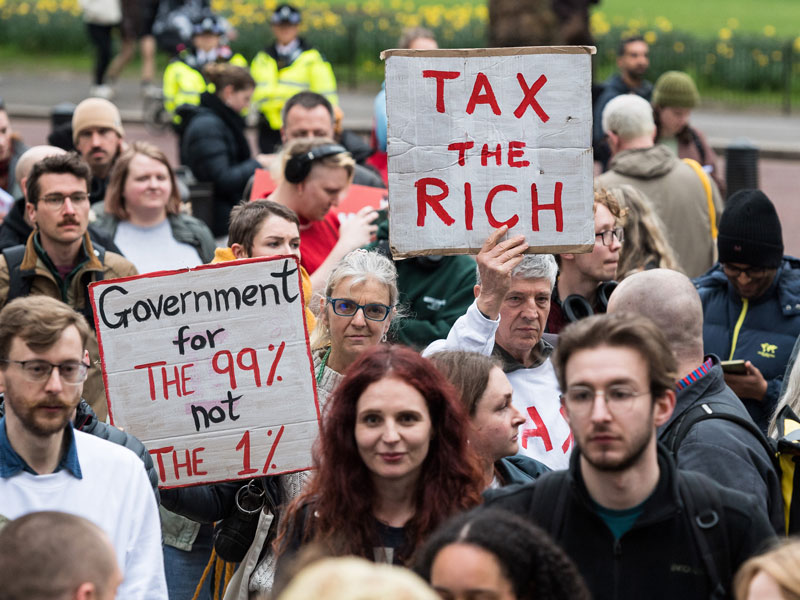
The crux of Stevenson’s proposal is a modest 1-2% wealth tax on assets exceeding £10 million. He is deliberately not advocating for increased income taxes, focusing instead on curbing the exponential growth of existing wealth that far outstrips even the highest earned incomes. This distinction is crucial, as it targets accumulated capital rather than earned wages, aiming to level the playing field and prevent the perpetual compounding of fortunes at the expense of broader economic opportunity.
A common counterargument to wealth taxation is the potential for capital flight, with the wealthy relocating to jurisdictions with more favorable tax regimes. Stevenson counters that many high-net-worth individuals are already departing the UK due to its diminishing purchasing power, a consequence of middle and working-class families struggling financially and reducing their spending. He argues that a wealth tax would prevent the super-rich from hoarding assets, thereby unlocking opportunities for homeownership, family formation, and increased economic activity for the broader population.
The global mobility of ultra-high-net-worth individuals and their businesses presents a significant challenge to any national wealth tax implementation. The ease with which capital can be moved to tax havens in the digital age raises questions about the efficacy of unilateral measures. Stevenson acknowledges that a truly effective wealth tax might necessitate international cooperation, a daunting prospect in an era where some jurisdictions, like Dubai, are actively reducing taxes to attract capital. Despite these systemic hurdles, Stevenson remains committed to his cause, recognizing that the "millionaire exodus" is already a reality to some extent, even without a wealth tax in place. His genuine concern for the financial well-being of the 99% underscores his dedication to a policy that may prove difficult to implement.

Stevenson’s influence appears to be resonating beyond online spheres. Zack Polanski, the newly elected leader of the UK’s Green Party, has also become a vocal proponent of a wealth tax, mirroring Stevenson’s proposed 2% rate on wealth above £10 million. Polanski, who himself has actively engaged in media to promote his agenda, featured Stevenson as an early guest on his new podcast. This alignment suggests that Stevenson’s advocacy is not only shaping grassroots opinion but is also gaining traction within established political parties, particularly those seeking to offer a progressive alternative.
While it’s an oversimplification to attribute the Green Party’s stance solely to influencer politics, the current political climate, often characterized by identity politics overshadowing nuanced economic discussions, has undoubtedly emboldened such proposals. As the UK approaches its next general election, Stevenson is keen to see his message of wealth taxation adopted by a wider array of voices, especially within working-class communities. The challenge lies in maintaining sufficient public attention and presenting these complex ideas in an accessible manner, ensuring they capture the imagination and translate into electoral support. The stark polarization between the left and right in the UK, coupled with the perceived convergence of the traditional Labour and Conservative parties, creates an environment where the Green Party’s progressive platform, bolstered by Stevenson’s economic arguments, could prove influential. The ultimate question for the electorate will be which issue – economic reform or identity politics – captures the public’s imagination more profoundly.
Stevenson’s recent announcement of an extended break, titled "Goodbye and Good Luck," on his "Gary’s Economics" channel, signals a recognition of the immense effort required to champion such a significant policy shift. While not an indication of abandoning his cause, it reflects an understanding of the long-term nature of this advocacy. He has directed his followers to support organizations like the Patriotic Millionaires and individuals like Zack Polanski, indicating that his influence will continue to be felt even during his hiatus. The battle for a more equitable economic future is a marathon, not a sprint, and Stevenson’s efforts have undoubtedly laid crucial groundwork for continued debate and potential policy change.