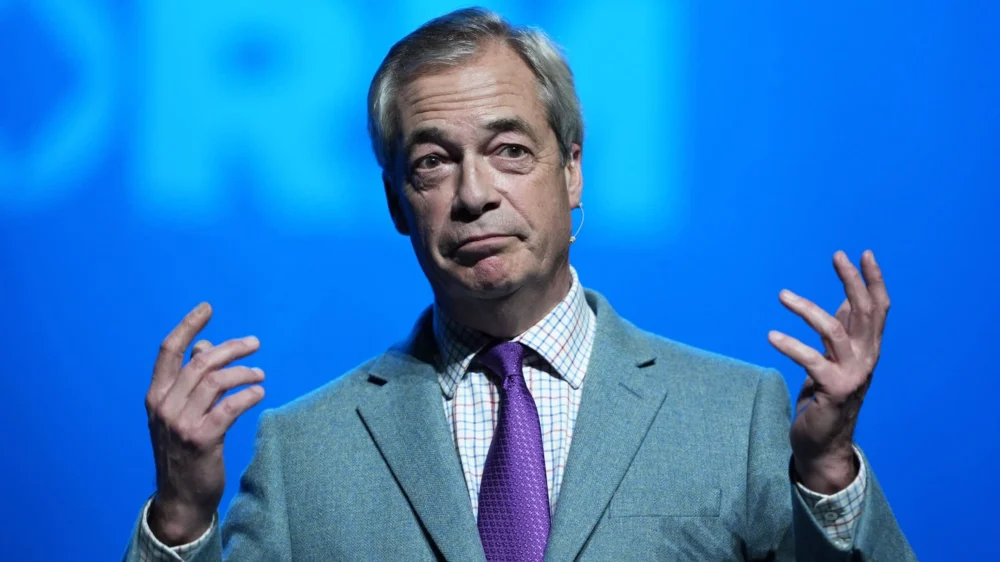
The annual gathering of the World Economic Forum in the snow-dusted enclave of Davos, Switzerland, has long served as the ultimate symbol of the globalist architecture that Nigel Farage spent decades attempting to dismantle. Yet, in a move that signals a profound shift in the tactical playbook of the British right, the man who arguably did more than any other to sever the United Kingdom’s ties with the European Union is set to descend upon the very summit he once characterized as a "jaunt" for the "unaccountable elite." This decision to attend the 2024 summit represents more than just a personal reversal; it highlights a burgeoning trend where the architects of anti-establishment sentiment are increasingly seeking to confront—or perhaps influence—the levers of global capital directly from within their own sanctuaries.
For years, Farage’s rhetoric was defined by a scorched-earth policy toward the "Davos Man," a term popularized by political scientist Samuel Huntington to describe those who view national borders as obstacles and see themselves as members of a globalized caste. To Farage’s base, Davos was the headquarters of a "Great Reset" conspiracy, a place where corporate titans and career politicians conspired to erode national sovereignty in favor of ESG (Environmental, Social, and Governance) mandates and open-border policies. His previous dismissals of the event were not merely critiques of its cost or its carbon footprint, but fundamental rejections of the "stakeholder capitalism" championed by WEF founder Klaus Schwab.
The timing of this pivot is particularly salient. As the United Kingdom continues to navigate the complex economic aftershocks of Brexit, Farage’s presence in Switzerland suggests a recognition that the battle for the UK’s economic future cannot be won solely through domestic populist appeals. With the British economy grappling with stagnant productivity and a shifting trade landscape, the "outsider" status that Farage cultivated is being traded for a seat at the table where global investment decisions are finalized. It is a move mirrored by other international figures, such as Argentina’s Javier Milei and former U.S. President Donald Trump, both of whom used the Davos platform to deliver uncompromising defenses of national interest while simultaneously courting the very billionaire class they frequently lampooned in campaign speeches.
From an economic perspective, Farage’s attendance coincides with a period of intense fragmentation in global trade. The era of "hyper-globalization" that defined the 1990s and early 2000s has given way to a more defensive "re-globalization," characterized by "friend-shoring" and protectionist industrial policies. In this environment, the traditional Davos consensus is under siege. By appearing at the summit, Farage positions himself as a bridge between the insurgent political movements of the West and the institutional investors who are increasingly wary of the geopolitical instability those movements often bring. His presence serves as a reminder to the financial elite that the populist wave is not a temporary fever but a permanent fixture of the modern political economy.
The ideological clash at the heart of this visit is centered on the future of the British state. While the current Labour government and the Conservative opposition have both sought to reassure international markets of Britain’s stability, Farage represents a more volatile, libertarian-leaning economic vision. His attendance at Davos allows him to pitch "Global Britain" in its most unfiltered form—low regulation, high competition, and a clean break from European social modeling. To the delegates at Davos, who represent roughly $10 trillion in managed assets, Farage’s message is a provocative alternative to the increasingly interventionist stances of the Biden administration or the European Commission.
Furthermore, the strategic utility of the Davos platform for a media-savvy politician cannot be overstated. The summit attracts over 2,500 world leaders, CEOs, and journalists, creating a concentrated echo chamber that can amplify a political brand with unparalleled efficiency. For Farage, whose Reform UK party has been making significant inroads in British polling, Davos offers a backdrop of gravitas. It allows him to transition from the role of a protest leader to that of a statesman-in-waiting, capable of navigating the halls of power even as he threatens to renovate them. This "inside-outside" strategy is designed to prove that he is not merely a disruptor, but a player whose influence must be factored into any long-term economic forecast for the British Isles.
However, this move is fraught with political risk. To his most ardent supporters, appearing at a forum that symbolizes the "liberal world order" could be interpreted as a betrayal of the very principles that fueled the Brexit movement. The imagery of Farage sipping coffee in a private lounge with the world’s banking elite stands in stark contrast to the "man of the people" persona he perfected in British pubs. To mitigate this, Farage is expected to use his time in the Alps to challenge the WEF’s orthodoxy on issues like Net Zero targets and central bank digital currencies. By framing his attendance as a "mission behind enemy lines," he can maintain his outsider credentials while reaping the benefits of elite networking.
The broader economic context of the summit also provides a fertile ground for Farage’s critiques. Global growth is projected to remain subdued, with the IMF forecasting a tepid 3.1% expansion in 2024. Inflation, while cooling, remains a structural threat in many Western economies, exacerbated by supply chain vulnerabilities and the transition to green energy—a transition Farage has frequently criticized as an expensive folly imposed by the Davos set. In his view, the WEF’s focus on climate change and social equity is a distraction from the fundamental task of generating economic growth through deregulation and tax competition.
Comparing Farage’s approach to other global populists reveals a sophisticated pattern of engagement. When Javier Milei addressed the forum in early 2024, he famously declared that "the Western world is in danger" due to a "collectivist" vision of the economy. His speech was a viral sensation, proving that the Davos stage can be hijacked to deliver a message diametrically opposed to the forum’s stated goals. Farage likely views his attendance through a similar lens—not as an endorsement of the WEF’s "Great Reset," but as an opportunity to deliver a "Great Reality Check" to the world’s most powerful decision-makers.
The impact of this visit on the UK’s internal politics could be substantial. As the Reform UK party seeks to peel away voters from a fractured Conservative base, Farage’s ability to command attention on the international stage reinforces his position as a primary architect of the British right. It signals to the City of London and international hedge funds that there is a political vehicle ready to champion a radical, free-market agenda should the traditional parties fail to deliver. In an era where "political risk" is a standard metric for investment, Farage is making himself a variable that can no longer be ignored.
Ultimately, Nigel Farage’s journey to Davos is a testament to the evolving nature of political influence in the 21st century. The line between the "globalist" and the "nationalist" is becoming increasingly blurred as both sides realize they operate within the same interconnected financial ecosystem. Whether Farage is there to burnish his credentials, court donors, or simply to troll the establishment, his presence marks a significant moment in the history of the World Economic Forum. It suggests that the "Davos consensus" is no longer a monologue delivered by the elite to the masses, but a contentious, multi-polar debate where the loudest critics have finally forced their way into the room. As the delegates discuss the "rebuilding of trust"—the theme of the recent summit—they must now do so with one of their most persistent adversaries watching from the front row.