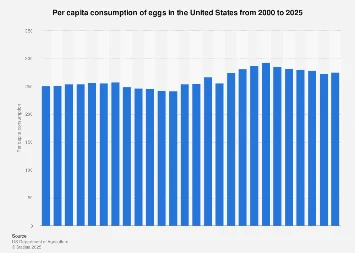
The United States is poised for a notable increase in its per capita egg consumption, with projections indicating a steady rise in demand for this versatile protein source. In 2024, the average American was estimated to consume approximately 272.9 eggs. This figure is anticipated to climb to 275.9 eggs per person by the year 2025, reflecting a sustained appetite for eggs across the nation. Per capita consumption, a key economic indicator, is calculated by taking total domestic egg production, subtracting exports, and then dividing the remainder by the total U.S. population. This metric provides a crucial snapshot of domestic demand and the overall health of the egg market within the country.
This anticipated growth occurs against a backdrop of dynamic shifts within the U.S. egg industry, most notably the increasing consumer interest in ethically sourced and "healthier" egg varieties. While the vast majority of laying hens in the United States continue to be housed in conventional cage systems, the production of cage-free and organic eggs has witnessed a significant upswing in recent years. This trend is driven by a confluence of consumer awareness regarding animal welfare, evolving dietary perceptions, and a growing willingness to pay a premium for products perceived as superior in quality or ethical production standards.
The distinction between cage-free and organic production, while often conflated by consumers, represents a nuanced spectrum of farming practices. In cage-free systems, hens are liberated from individual confinement, allowing them to roam freely within a larger barn environment. However, it is crucial to note that "cage-free" does not automatically equate to idyllic conditions. Depending on the specific operation, these environments can still be densely populated, and the quality of the living space and access to external areas can vary significantly. Organic production, on the other hand, mandates a more stringent set of criteria. Organic certified hens are not only housed in cage-free environments but are also required to have access to outdoor spaces, and their feed must be produced without synthetic pesticides or fertilizers. This emphasis on natural inputs and greater freedom of movement contributes to the premium price point associated with organic eggs.
The U.S. egg industry itself has demonstrated remarkable resilience and a capacity for steady expansion. For decades, the total number of eggs produced annually within the United States saw consistent growth, mirroring the increasing demand. Similarly, the total inventory of laying hens, a fundamental driver of production, had been on an upward trajectory for many years, until a notable plateau and subsequent adjustment around 2019. This period of expansion underscores the industry’s ability to scale operations to meet market needs. Geographically, the concentration of egg production remains significant in certain states, with Iowa consistently leading the nation. As of 2022, Iowa was home to an estimated 43 million laying hens, solidifying its position as the agricultural powerhouse for egg production in the U.S. This regional specialization highlights the importance of agricultural infrastructure, feed availability, and supportive regulatory environments in sustaining large-scale livestock operations.
The economic implications of these trends are substantial. The increasing demand for cage-free and organic eggs is reshaping investment strategies within the industry. Producers are facing pressure to adapt their facilities to meet these evolving consumer preferences, often requiring significant capital expenditures. This transition can be challenging, particularly for smaller operations, and may lead to consolidation within the sector. Furthermore, the price differential between conventional and alternative egg types creates opportunities for premium branding and targeted marketing. As consumers become more discerning, the ability of egg producers to clearly communicate their farming practices and the benefits of their products will be paramount.
Globally, the U.S. egg market operates within a broader international context. While the U.S. is a major producer and consumer, other regions also exhibit significant egg consumption patterns. For instance, countries in Southeast Asia, such as China and Indonesia, have very high per capita egg consumption, often driven by affordability and traditional dietary staples. European Union countries also maintain substantial egg consumption, with a growing emphasis on cage-free production mirroring trends in the U.S. However, the regulatory frameworks and consumer drivers can differ. For example, the EU has implemented stricter regulations on conventional cage systems, accelerating the shift towards alternative housing methods.
The forecasted increase in U.S. per capita egg consumption is not merely a statistical blip; it represents a nuanced interplay of economic forces, consumer psychology, and agricultural innovation. As the industry navigates the growing demand for ethically produced and potentially healthier options, it must balance the significant investments required for modernization with the imperative of maintaining affordability and accessibility for a broad consumer base. The continued dominance of conventional production methods suggests that while alternative options are gaining traction, they have not yet supplanted the cost-effectiveness and scale of traditional farming. The coming years will likely see continued adaptation, with producers seeking to optimize their operations to cater to a diverse range of consumer preferences and regulatory landscapes, all while ensuring the continued supply of this fundamental food commodity. The humble egg, it appears, remains a cornerstone of the American diet, and its future consumption patterns will be a bellwether for broader trends in sustainable agriculture and consumer-driven market evolution.