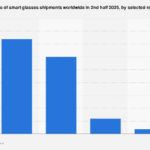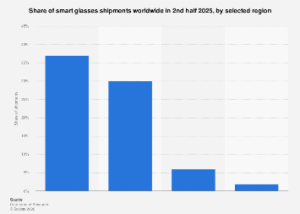



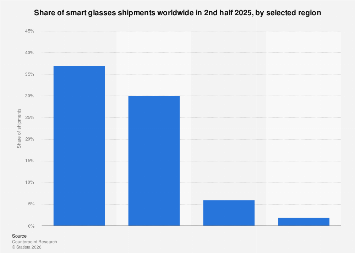
The nascent smart glasses market is poised for a dramatic reshaping of its regional shipment landscape by 2025, with emerging economies and established technology hubs vying for dominance. While North America and Asia-Pacific are expected to remain the primary drivers of demand, the pace of adoption and the specific applications of augmented reality (AR) and mixed reality (MR) eyewear will vary considerably across different geographical segments. Projections indicate a robust compound annual growth rate (CAGR) for the global smart glasses sector, driven by advancements in hardware, the expansion of enterprise use cases, and a gradual increase in consumer acceptance.
The intricate tapestry of the global smart glasses market by 2025 will be woven with distinct regional threads, each contributing to the overall narrative of this transformative technology. North America, historically a frontrunner in technology adoption, is projected to maintain a significant, albeit potentially less rapidly growing, share of shipments. This region benefits from a mature consumer electronics market, a strong presence of pioneering tech companies, and substantial investment in AR/MR research and development. Early adopters and a higher disposable income contribute to a sustained demand for innovative wearable devices. Furthermore, the robust enterprise sector in North America, encompassing industries like manufacturing, logistics, and healthcare, is actively integrating smart glasses for enhanced productivity, training, and remote assistance, thereby solidifying its market position.
Conversely, the Asia-Pacific region is anticipated to experience the most dynamic growth, potentially challenging North America’s long-held leadership in shipment volumes. This surge is fueled by several interconnected factors. Firstly, the sheer size of the population and the burgeoning middle class in countries like China, India, and South Korea represent a vast untapped market for consumer electronics, including smart glasses. As these economies continue to develop, a growing segment of consumers will have the purchasing power and the technological inclination to embrace AR/MR devices. Secondly, governments and private enterprises within the Asia-Pacific are making substantial investments in digital transformation initiatives, with AR/MR technologies being central to these strategies. Smart city projects, advanced manufacturing upgrades, and the development of sophisticated entertainment and gaming ecosystems are all expected to drive significant demand for smart glasses. The region’s prowess in hardware manufacturing also positions it as a key production hub, potentially leading to more cost-effective devices and further accelerating adoption.
Europe presents a more nuanced picture, characterized by a blend of strong industrial demand and a cautious consumer market. Western European nations, with their advanced economies and a focus on industrial automation and digitalization, are expected to see steady growth in enterprise-level smart glasses deployment. Sectors such as automotive, aerospace, and construction are leveraging AR/MR for design, maintenance, and on-site operations. However, consumer adoption in Europe may lag slightly behind North America and Asia-Pacific, influenced by varying data privacy concerns, cultural preferences, and the availability of compelling consumer applications. Nevertheless, the region’s commitment to innovation and its well-established consumer electronics retail channels provide a solid foundation for future market expansion.
The Middle East and Africa (MEA) region, while currently representing a smaller share of the global smart glasses market, holds significant long-term potential. Rapid urbanization, substantial investments in smart infrastructure, and a growing youth population keen on adopting new technologies are key drivers. Early adoption is likely to be concentrated in the Gulf Cooperation Council (GCC) countries, where governments are actively pursuing ambitious digital transformation agendas. Sectors such as tourism, education, and retail are exploring the use of AR/MR to enhance customer experiences and operational efficiency. As the cost of devices decreases and more localized content becomes available, the African continent is also expected to witness a gradual increase in smart glasses adoption.
Latin America is another region poised for growth, albeit from a smaller base. Brazil, Mexico, and Argentina are emerging as key markets, driven by a growing middle class, increasing internet penetration, and a vibrant technology startup scene. The entertainment and gaming sectors are anticipated to be early adopters of consumer smart glasses, followed by enterprise applications in fields like agriculture and mining, where AR can provide valuable real-time data and operational support in remote or challenging environments. Economic volatility and infrastructure challenges in some parts of the region may present headwinds, but the overall trend points towards increasing market penetration.
The economic implications of these regional shifts are profound. The widespread adoption of smart glasses across various industries is expected to unlock significant productivity gains, streamline complex processes, and create new avenues for customer engagement. For businesses, this translates to potential cost savings through improved training, reduced errors, and enhanced operational efficiency. The development of specialized AR/MR applications for different sectors will foster innovation and create new market opportunities for software developers and content creators. The manufacturing sector will see a renewed focus on producing these advanced wearable devices, potentially leading to job creation and the resurgence of domestic electronics manufacturing capabilities in certain regions.
However, this technological transition is not without its challenges. Concerns regarding data privacy, cybersecurity, and the ethical implications of pervasive AR/MR technology need to be addressed proactively by both regulators and industry players. The digital divide, both within and between regions, could exacerbate existing inequalities if access to these advanced technologies is not equitable. Furthermore, the development of a robust ecosystem of applications and content that caters to diverse regional needs and preferences will be crucial for sustained market growth. Interoperability standards and the seamless integration of smart glasses with existing technological infrastructure will also be key factors determining the pace of adoption.
Looking ahead, the smart glasses market is expected to evolve from primarily enterprise-focused solutions to a more balanced consumer and enterprise landscape. As hardware becomes more sophisticated, affordable, and aesthetically pleasing, consumer adoption will accelerate, driven by gaming, social media, and personalized augmented experiences. The interplay between these regional dynamics, technological advancements, and evolving consumer and enterprise needs will shape the future of smart glasses, making it one of the most exciting and consequential technology markets to watch in the coming years. The projected shifts in shipment share by 2025 underscore the dynamic nature of the global technology landscape and the increasing importance of emerging markets in driving the next wave of digital innovation.