
The recent escalation of hostilities in the Middle East, characterized by direct missile exchanges between Iran and Israel, has sent tremors through global markets, yet the most profound impact may not be found in the immediate fluctuation of crude oil prices, but in the structural vulnerabilities exposed by the world’s reliance on American economic leadership. As the United States intensifies its use of financial sanctions, trade restrictions, and "friend-shoring" as primary tools of foreign policy, a growing number of middle powers and developed economies are beginning to question the long-term viability of an economic order that is increasingly indistinguishable from American national security interests. The fallout from the Iran-Israel confrontation serves as a stark reminder that while the U.S. security umbrella offers protection, the economic strings attached to it can create significant collateral damage for those following Washington’s lead.
For decades, the global economic system operated under the assumption that trade liberalization and interconnectedness would serve as a bulwark against major conflict. However, the paradigm has shifted toward "geoeconomic fragmentation," a term increasingly utilized by the International Monetary Fund (IMF) to describe the splitting of the world into rival economic blocs. The U.S. strategy of "de-risking" from adversaries—most notably China and Iran—has forced its allies in Europe and Asia to make difficult choices that often run counter to their own domestic economic health. When Iran launched its barrage of ballistic missiles, the immediate reaction in the West was a call for tighter sanctions; yet, for countries in the European Union and the Indo-Pacific, these measures often translate into higher energy costs and the loss of lucrative export markets.
The energy sector remains the most sensitive pressure point in this geopolitical calculus. The Strait of Hormuz, a narrow waterway through which approximately 20% of the world’s total oil consumption passes, remains under the shadow of Iranian influence. While the United States has achieved a level of energy independence through the shale revolution, making it a net exporter of petroleum, its allies in the G7 remain deeply vulnerable. For Japan, South Korea, and much of the Eurozone, a disruption in Middle Eastern supply is not merely a fiscal inconvenience but an existential threat to industrial output. By following the U.S. lead in isolating Iran, these nations have effectively traded diverse energy security for a unified political front, a gamble that becomes increasingly expensive each time tensions boil over.
Market data reflects this underlying anxiety. Following the latest round of attacks, Brent crude futures saw significant volatility, with analysts at Goldman Sachs and Morgan Stanley warning that a sustained conflict could add a "geopolitical premium" of $10 to $20 per barrel. For a global economy already struggling to tame inflation and manage high interest rates, such a spike is a recipe for stagflation. The U.S. Federal Reserve may have the luxury of focusing on domestic labor markets, but central banks in emerging economies are forced to defend their currencies against a surging U.S. dollar, which traditionally acts as a safe haven during Middle Eastern crises. This "dollar trap" means that as the U.S. pursues its geopolitical objectives, the resulting financial turbulence disproportionately penalizes developing nations that have no say in Washington’s policy deliberations.
Furthermore, the weaponization of the global financial system—specifically the SWIFT messaging network and the dominance of the U.S. dollar—has reached a tipping point. The aggressive use of secondary sanctions against those doing business with Iran has served as a catalyst for the BRICS+ nations to accelerate their search for alternative payment systems. China, Russia, and even U.S. allies like India have explored "de-dollarization" strategies, not necessarily out of ideological alignment with Tehran, but out of a pragmatic need to insulate their economies from the whims of the U.S. Treasury Department. The peril for those following America’s lead is that they may find themselves on the wrong side of a bifurcated global financial architecture, losing access to the growth engines of the Global South in exchange for continued participation in a Western-centric system that is becoming increasingly exclusionary.
Expert insights suggest that the current U.S. approach to economic statecraft is creating a "compliance fatigue" among its partners. In Europe, the concept of "strategic autonomy" has moved from a fringe academic idea to a central pillar of French and German policy discussions. The lesson learned from the Iran nuclear deal (JCPOA) remains a bitter one for European capitals: after years of negotiating a framework that allowed for legitimate trade with Iran, the U.S. unilaterally withdrew and imposed sanctions that crippled European firms. This unpredictability makes it difficult for global corporations to engage in long-term capital expenditure, as the legal landscape can shift overnight based on the electoral cycles in Washington.
The economic impact analysis of this alignment also extends to the technology sector. The U.S. has pressured its allies to adopt a "small yard, high fence" approach to technology transfers, ostensibly to prevent dual-use technologies from reaching actors like Iran’s Revolutionary Guard or its regional proxies. However, the definition of the "yard" continues to expand, encompassing everything from semiconductors to green energy components. For countries like Germany or the Netherlands, whose economies are built on high-tech exports, the restriction of trade with "unfriendly" nations represents a significant contraction of their addressable market. The cost of following the U.S. economic lead is thus a forced pivot away from globalized supply chains toward fragmented, localized, and more expensive alternatives.
Global comparisons illustrate the disparity in how these shocks are absorbed. In the United States, the defense industrial base often sees a surge in orders and stock valuations during periods of Middle Eastern instability. Conversely, in the manufacturing hubs of Southeast Asia, the rise in shipping insurance premiums and the necessity of rerouting vessels around the Cape of Good Hope—to avoid the Houthi-targeted Red Sea—add layers of cost that erode thin margins. The "security first" economic model advocated by Washington assumes that all participants have the fiscal space to absorb these costs, an assumption that is increasingly detached from the reality of debt-laden European and emerging market economies.
Moreover, the psychological impact on global investors cannot be overstated. The realization that economic policy is now a subservient arm of military and intelligence strategy has led to a "wait-and-see" approach in foreign direct investment. When the U.S. signals that it will use its economic might to punish Iran for its regional provocations, it also signals to the rest of the world that any country could be next if its interests diverge from Washington’s. This perceived capriciousness undermines the stability that once made the American-led order so attractive.
In the long term, the perils of following America’s economic lead lie in the erosion of the very institutions that the U.S. helped build. The World Trade Organization (WTO) has been largely sidelined as "national security exceptions" become the standard justification for protectionist measures. As the U.S. focuses on containing Iran and other adversaries through economic strangulation, it risks creating a world where trade is no longer governed by rules, but by the relative power of the actors involved. For smaller and middle-power nations, this return to a "might makes right" economic landscape is a regression that threatens decades of prosperity.
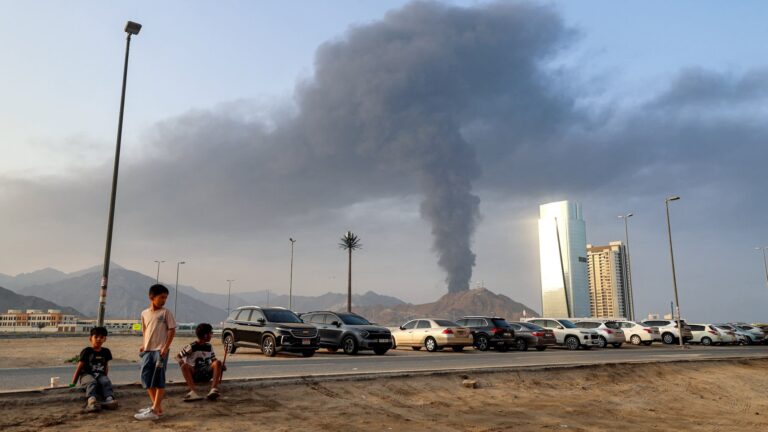
As the smoke clears from the latest missile batteries, the economic reality remains: the world is more divided, more expensive, and more volatile than it was before the current cycle of escalation began. The U.S. doctrine of using economic leverage to achieve political ends has undoubtedly hampered Iran’s capabilities, but it has also placed a heavy burden on the global community. For those who have traditionally followed America’s lead, the cost of loyalty is rising. The challenge for the coming decade will be for these nations to find a path that maintains their security alliances without sacrificing their economic sovereignty to a strategy that prioritizes Washington’s short-term geopolitical goals over global long-term stability. The Iran attacks were a military event, but their true legacy may be the acceleration of a global shift away from an American-led economic consensus that many now view as too risky to follow.