


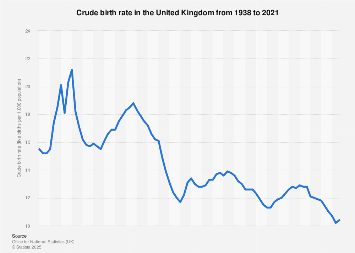
The United Kingdom’s crude live birth rate has plunged to a historic low of 10.4 births per 1,000 population in 2021, marking a significant deceleration in national procreation trends. This figure represents a sustained decline from the 12.9 births per 1,000 population recorded in 2010, underscoring a multi-year demographic shift. While the 2021 figure represents the lowest point in recent recorded history, a historical perspective reveals that the peak of the UK’s birth rate post-1938 occurred in 1947, with a robust 21.2 births per 1,000 population.
The latest official figures for 2021 are derived from an estimated 694,685 live births and a mid-year population estimate of approximately 67 million individuals across the United Kingdom. This crude birth rate is intrinsically linked to the Total Fertility Rate (TFR), a key metric that estimates the average number of children a woman is expected to have over her lifetime. In 2021, the UK’s TFR stood at 1.53 children per woman, a figure well below the replacement level of 2.1, which is generally considered necessary to maintain a stable population without considering migration.
Examining the constituent nations within the UK reveals variations in these demographic patterns. Northern Ireland recorded the highest birth rate among the four nations in 2021, with 11.6 births per 1,000 population. England followed closely with 10.5 births per 1,000, while Wales registered 9.3 and Scotland reported the lowest rate at 8.7 births per 1,000 population. These regional disparities, while nuanced, collectively contribute to the overarching national trend.
The demographic trajectory observed in the United Kingdom is not an isolated phenomenon but rather a reflection of a broader global pattern. Across numerous developed and developing nations, fertility rates have witnessed a dramatic decline since the mid-20th century. Data from 2021 indicates that fertility rates in Asia, Europe, and the Americas have all fallen below the crucial two-child threshold. Globally, the average fertility rate in 2021 was 2.31 births per woman. Africa, while exhibiting the highest regional fertility rate at 4.12 births per woman, has also experienced a notable decrease from its peak of 6.72 in the late 1960s.
Several interconnected factors are widely recognized as drivers of these declining fertility rates. Significant advancements in public health, leading to a substantial reduction in infant and child mortality, have historically played a crucial role. As fewer children are lost in infancy, families may feel less compelled to have a larger number of offspring to ensure the continuation of the lineage. Concurrently, improved access to and widespread availability of modern contraception have empowered individuals, particularly women, to make more informed decisions about family planning and spacing of births. These factors, combined with increasing educational attainment for women, greater participation in the workforce, rising costs of raising children, and evolving societal norms around family size, have collectively contributed to the global demographic recalibration.
The economic implications of a sustained decline in birth rates are multifaceted and can have profound long-term consequences for national economies. A shrinking birth rate directly impacts the future labor force. With fewer young people entering the workforce, countries may face labor shortages, potentially hindering economic growth and productivity. This can lead to increased competition for skilled workers and potentially drive up wages. Governments may also experience a strain on public finances as the dependency ratio – the proportion of non-working individuals (children and the elderly) to working-age individuals – increases. This can translate into higher pension burdens, increased healthcare costs for an aging population, and a reduced tax base to fund public services.
Furthermore, declining birth rates can affect consumption patterns and market demand. A smaller younger generation may lead to reduced demand for certain goods and services typically associated with families, such as education, childcare, and larger housing. Conversely, demand for goods and services catering to an aging population, such as healthcare, pharmaceuticals, and leisure activities for seniors, may rise. Businesses will need to adapt their strategies to cater to these shifting consumer demographics.
In response to these demographic shifts, policymakers in many countries are exploring various strategies. These can include incentives for having children, such as enhanced parental leave policies, subsidized childcare, and tax breaks for families. Immigration policies are also often considered as a means to offset declining birth rates and maintain a viable workforce. However, such policies are often complex and involve significant social and political considerations.
The persistent decline in the UK’s birth rate, mirroring global trends, presents a significant demographic challenge. It necessitates careful consideration of its economic, social, and policy implications. As the nation grapples with a lower fertility rate and an aging population, strategic planning will be crucial to ensure sustained economic prosperity and social well-being in the decades to come. The ability to adapt to these evolving demographic realities will be a defining characteristic of the UK’s future.