


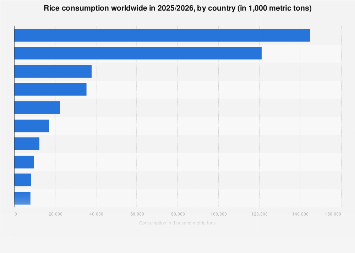
Global demand for rice, a staple food for over half the world’s population, is projected to remain robust through the 2025/26 period, underscoring its pivotal role in food security and international trade. While precise consumption figures for individual countries often require specialized market intelligence access, broader trends and economic analyses paint a clear picture of sustained and, in many regions, increasing reliance on this fundamental grain. The anticipated consumption patterns are intrinsically linked to demographic shifts, evolving dietary habits, agricultural productivity, and the economic viability of rice cultivation and distribution across key producing and consuming nations.
Asia, home to the vast majority of rice consumers, will continue to dominate global consumption figures. Countries like China and India, with their enormous and growing populations, will remain the largest individual markets for rice. Projections indicate that per capita consumption in these nations, while potentially seeing marginal shifts due to diversification of diets and increasing incomes, will maintain significant levels. This sustained demand from Asia has profound implications for global rice prices, trade flows, and the agricultural policies of both importing and exporting countries. For instance, fluctuations in the monsoon season or government subsidies in these major markets can send ripples through the international commodity markets, affecting nations as far afield as the United States and Brazil, which are significant exporters.
Beyond Asia, rice consumption is also substantial in other regions, albeit with varying growth trajectories. Sub-Saharan Africa, for example, has witnessed a steady increase in rice consumption over the past two decades, driven by population growth, urbanization, and a shift away from traditional staples in some areas. This trend positions African nations as increasingly important players in the global rice market, both as consumers and, in some cases, as emerging producers. The economic impact here is multifaceted: it influences foreign exchange reserves spent on imports, creates opportunities for domestic agricultural development, and impacts food affordability for large segments of the population.
The economic implications of these consumption patterns are far-reaching. For producing nations, rice cultivation is a vital source of employment and income for millions of smallholder farmers. Government policies aimed at supporting rice production, such as subsidies for fertilizers, irrigation, and seed varieties, are crucial for ensuring stable domestic supply and export competitiveness. Conversely, for importing countries, rice represents a significant expenditure in their balance of payments, making efficient trade agreements and stable global prices paramount. The price of rice is not merely a matter of market forces; it is a sensitive indicator of food security and can directly influence social stability.
Global rice production is largely concentrated in a few key countries, with China, India, Indonesia, Bangladesh, and Vietnam consistently leading the pack. The interplay between production capacity and consumption demand dictates global trade volumes and price benchmarks. Any disruption to production in these major agricultural powerhouses, whether due to climate change-induced weather events, pest outbreaks, or geopolitical factors, can have immediate and significant consequences on global rice availability and prices. For example, a severe drought in Southeast Asia could reduce exportable supplies from Vietnam and Thailand, two of the world’s largest rice exporters, leading to price hikes for importing nations across Africa and the Middle East.
Market data and expert analyses suggest that while overall global rice consumption is expected to grow, the rate of growth might moderate in some developed economies where dietary diversification is more pronounced. However, the sheer volume of consumption in populous Asian nations, coupled with the rising demand in Africa and parts of Latin America, will ensure continued upward pressure on global demand. This sustained demand presents both opportunities and challenges for the international agribusiness sector, necessitating investments in sustainable farming practices, resilient supply chains, and innovative solutions to enhance yield and reduce post-harvest losses.
The economic significance of rice extends beyond its role as a staple food. It is a commodity that underpins the livelihoods of a substantial portion of the global agricultural workforce. The economic health of rice-dependent economies is closely tied to the productivity and profitability of their rice sectors. Therefore, understanding the future consumption trends is not just an academic exercise but a critical component of economic forecasting, agricultural policy development, and international development initiatives aimed at enhancing food security and reducing poverty.
The projected consumption figures for 2025/26 will also be influenced by technological advancements in agriculture. Innovations in crop genetics, precision farming, and water management could potentially boost production and make rice cultivation more resilient to environmental challenges. These advancements, if widely adopted, could help meet the growing demand without necessarily requiring a proportional increase in land use, a crucial consideration in a world facing competing demands for land resources. Furthermore, improvements in storage and transportation infrastructure are vital to minimize post-harvest losses, which can be substantial in many rice-producing regions, thereby increasing the effective supply of rice available for consumption.
The economic impact of rice consumption is also evident in the global trade statistics. Rice is a globally traded commodity, with significant volumes moving between continents. The value of this trade runs into billions of dollars annually, supporting shipping industries, logistics networks, and financial services. Major exporting countries rely on rice revenues for foreign exchange earnings, which can be crucial for funding national development projects. Conversely, importing countries leverage rice trade to supplement domestic production and ensure food security for their populations, a critical consideration for governments facing demographic pressures and potential supply chain disruptions.
As the world moves towards 2025/26, the consistent and significant global demand for rice will continue to shape agricultural economies, influence international trade dynamics, and remain a cornerstone of food security strategies worldwide. The intricate web of production, consumption, trade, and policy surrounding this essential grain will continue to be a focal point for economists, policymakers, and stakeholders across the global agricultural landscape. The economic stability and food security of a considerable portion of the world’s population remain inextricably linked to the future of rice cultivation and consumption.