
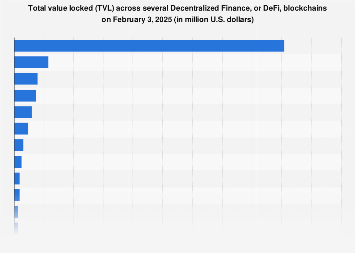
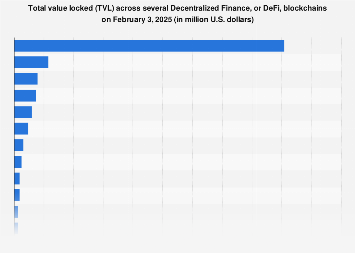
As of September 5, 2025, the total value locked (TVL) across the decentralized finance (DeFi) ecosystem paints a clear picture of market leadership, with Ethereum continuing to command an overwhelming majority of the total locked assets. TVL serves as a key metric, offering a proxy for the overall market size and the depth of capital committed to decentralized financial protocols. While specific figures for September 5, 2025, are not publicly disclosed without subscription, historical trends and market analysis indicate a robust and dynamic DeFi sector, with Ethereum’s dominance remaining a central theme.
The DeFi market experienced significant expansion throughout 2021, reaching unprecedented levels of capital inflow and protocol adoption. This surge was intrinsically linked to the performance and utility of Ethereum, the foundational blockchain for a vast majority of DeFi applications. Consequently, price fluctuations of Ether, Ethereum’s native cryptocurrency, have a pronounced impact on the reported TVL. For instance, a notable event on September 10, 2021, saw Ethereum’s TVL experience a substantial decline exceeding billions of U.S. dollars, directly correlated with an overnight price drop in Ether. This sensitivity underscores the interconnectedness of the crypto asset market and the DeFi ecosystem it supports.
Beyond Ethereum, a diverse array of other blockchains are actively developing and hosting DeFi applications. These "Ethereum competitors" or "Layer 1 alternatives" are striving to offer enhanced scalability, lower transaction fees, and novel functionalities to attract developers and users. Blockchains such as Solana, Binance Smart Chain (now BNB Chain), Avalanche, Cardano, Polkadot, and others have been steadily growing their TVL, each carving out a niche based on their technological strengths and community engagement. The competition among these platforms is fostering innovation, pushing the boundaries of what is possible in decentralized finance.
The growth trajectory of DeFi is not solely dictated by technological advancements but also by regulatory clarity, institutional adoption, and macroeconomic conditions. As global financial markets navigate inflation, interest rate hikes, and geopolitical uncertainties, the DeFi space is subject to these broader economic forces. Investors are increasingly scrutinizing the risk-reward profiles of DeFi protocols, leading to more discerning capital allocation. This maturation phase is expected to favor protocols with strong fundamentals, robust security, and sustainable economic models.
Looking ahead to 2025, projections for DeFi TVL across various blockchains will likely reflect a multi-chain future, even with Ethereum’s sustained leadership. The ongoing development of Layer 2 scaling solutions for Ethereum, such as Optimism, Arbitrum, and zk-rollups, is crucial for addressing Ethereum’s inherent scalability limitations. These solutions aim to process transactions off the main Ethereum chain, significantly increasing throughput and reducing gas fees, thereby making DeFi applications more accessible and cost-effective for a broader user base. The success of these Layer 2 networks will be a significant factor in maintaining Ethereum’s dominance while also creating new avenues for growth within its ecosystem.
The narrative of DeFi is also evolving to encompass a wider range of financial services beyond simple lending and trading. We are seeing the emergence of decentralized insurance, derivatives, asset management, and even real-world asset tokenization. The integration of traditional finance (TradFi) with DeFi, often referred to as "hybrid finance," is another area of significant potential. As regulatory frameworks become more defined, we can expect increased participation from traditional financial institutions looking to leverage the efficiency and transparency of blockchain technology.
Market data, when available, for various blockchains hosting DeFi protocols typically categorizes TVL by protocol type. This allows for a deeper understanding of where capital is being deployed – whether in decentralized exchanges (DEXs), lending protocols, yield farming aggregators, or synthetic asset platforms. The relative performance of these protocol categories can indicate shifts in investor sentiment and demand for specific DeFi services. For example, a surge in TVL within lending protocols might signal increased demand for borrowing or a greater appetite for earning interest on stablecoins.
Global comparisons of DeFi adoption reveal varying levels of penetration across different regions. Emerging markets, in particular, are exploring DeFi as a means to provide access to financial services for unbanked and underbanked populations. The lower barriers to entry and the potential for higher yields in some DeFi applications can be particularly attractive in economies with less developed traditional financial infrastructure. However, challenges related to internet accessibility, digital literacy, and regulatory uncertainty persist in these regions.
The economic impact of DeFi extends beyond the cryptocurrency market. By disintermediating traditional financial institutions, DeFi has the potential to reduce costs, increase efficiency, and foster greater financial inclusion. However, the inherent risks associated with smart contract vulnerabilities, market volatility, and potential regulatory crackdowns cannot be overlooked. The continued growth and mainstream adoption of DeFi will hinge on its ability to address these challenges and build trust among a wider audience of users and institutions.
As of the projected date of September 5, 2025, the DeFi landscape will likely be characterized by a more mature and diversified ecosystem. While Ethereum is expected to retain its leading position, the innovation and growth witnessed on competing Layer 1 blockchains and Layer 2 scaling solutions will continue to shape the competitive dynamics. The interplay between technological advancement, regulatory evolution, and macroeconomic factors will ultimately determine the pace and direction of decentralized finance in the coming years, solidifying its role as a significant force in the global financial system. The ability of platforms to demonstrate robust security, user-friendly interfaces, and sustainable economic models will be paramount in attracting and retaining capital, driving the overall expansion of the DeFi market.