
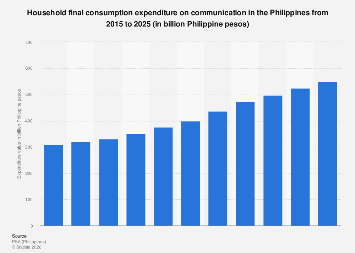
The Philippines’ burgeoning digital economy is set to propel household expenditure on communication services to new heights, with projections indicating a substantial increase by 2025. This trend underscores the nation’s rapid embrace of digital technologies, the growing demand for seamless connectivity, and the evolving role of communication in daily life and economic activity. As the archipelago navigates its post-pandemic recovery and charts a course for sustained growth, understanding these consumer spending patterns offers critical insights into the health and trajectory of its telecommunications sector and broader economic landscape.
This anticipated rise in household communication expenditure is not merely a statistical forecast; it is a reflection of fundamental shifts in consumer behavior and infrastructure development. The widespread adoption of smartphones, the increasing reliance on social media and digital platforms for information and entertainment, and the growing necessity of robust internet access for remote work, online education, and e-commerce are all converging to drive this upward momentum. As more Filipinos gain access to affordable data plans and a wider array of communication services, their willingness and ability to spend on these essential utilities are expected to climb.
The telecommunications industry in the Philippines has been undergoing a significant transformation, marked by intense competition and substantial investments in network expansion and technological upgrades. The entry of new players and the aggressive deployment of 4G and nascent 5G networks have been instrumental in improving service quality and driving down average revenue per user (ARPU) in some segments, while simultaneously increasing overall subscriber numbers and data consumption. This competitive environment has, in turn, incentivized service providers to offer more attractive packages and innovative solutions, further stimulating household spending.
Globally, the trend of increasing communication expenditure is not unique to the Philippines. Many emerging economies are witnessing a similar pattern as they bridge the digital divide and integrate more deeply into the global digital ecosystem. However, the Philippines’ archipelago geography presents unique challenges and opportunities for telecommunications companies. Expanding network coverage to remote islands and rural areas requires significant capital investment and logistical planning. Despite these hurdles, the government’s push for digital transformation, coupled with private sector initiatives, is steadily improving connectivity across the nation.
Several key drivers are fueling the projected increase in household communication spending. Firstly, the proliferation of smartphones continues unabated. These devices are no longer considered luxury items but essential tools for communication, information access, and participation in the digital economy. As more households acquire smartphones, the demand for mobile data, voice calls, and messaging services naturally escalates. Industry reports suggest that smartphone penetration rates in the Philippines are among the highest in Southeast Asia, and this trend is expected to continue.
Secondly, the rise of the digital economy has made reliable internet access a prerequisite for economic participation. With the growth of e-commerce, online freelancing, and the gig economy, households are increasingly investing in broadband internet services, both fixed and mobile, to support these income-generating activities. The COVID-19 pandemic, in particular, accelerated the adoption of remote work and online learning, highlighting the critical importance of robust internet infrastructure and prompting many households to upgrade their existing plans or subscribe to higher-speed services. This sustained demand for enhanced connectivity is a significant contributor to increased communication expenditure.
Thirdly, the consumption of digital content – from streaming video and music to online gaming and social media engagement – continues to grow exponentially. These activities are data-intensive and require substantial bandwidth, leading consumers to opt for more generous data plans and unlimited or high-volume packages. The affordability of these services, driven by competition, further encourages higher consumption levels. As entertainment and social interaction increasingly move online, households are allocating a larger portion of their discretionary income to communication services that facilitate these activities.
Furthermore, the government’s commitment to digital transformation initiatives, such as the National Broadband Program and the digitalization of government services, is creating a more conducive environment for increased communication spending. These initiatives aim to expand internet access to underserved areas and promote digital literacy, thereby bringing more Filipinos online and increasing their engagement with digital communication services. The ongoing development of digital payment systems and online government portals also necessitates and encourages greater use of digital communication channels.
Looking at market data, the telecommunications sector in the Philippines has consistently shown robust growth. While specific figures for 2025 household expenditure are proprietary forecasts, broader industry trends provide a strong indication. The country’s telecommunications revenue has been on an upward trajectory, driven by mobile data consumption and expanding broadband subscriptions. Analysts point to a consistent year-on-year growth rate in the sector, which is expected to be sustained as digital adoption deepens. The average monthly spending per user on telecommunication services, while varying across income brackets, is anticipated to see an increase as consumers opt for premium services and higher data allowances.
The economic impact of this rising household expenditure on communication is multifaceted. For the telecommunications companies, it translates into increased revenue, enabling further investment in infrastructure development, research, and development. This, in turn, creates jobs within the sector and its related industries, such as device manufacturing and software development. The improved connectivity also has a multiplier effect on other sectors of the economy, facilitating business operations, enhancing productivity, and fostering innovation across various industries.
Moreover, increased communication spending contributes to greater financial inclusion. As more Filipinos access digital platforms for banking and financial services, the reliance on physical branches diminishes, and the reach of financial services expands to remote areas. This digital shift, powered by enhanced communication infrastructure, can lead to more efficient resource allocation and greater economic participation for a larger segment of the population.
However, the rising expenditure also brings to the fore issues of affordability and digital divide. While overall spending is projected to increase, it is crucial to ensure that these services remain accessible to all segments of society, particularly low-income households. The government and telecommunications providers face the ongoing challenge of bridging the digital divide and ensuring that no one is left behind in the digital transformation. Initiatives such as subsidized internet plans for low-income families and public Wi-Fi hotspots in underserved areas are vital in this regard.
In conclusion, the projected surge in Philippine household expenditure on communication services by 2025 is a testament to the nation’s rapid digital evolution. This trend is underpinned by a confluence of factors, including smartphone penetration, the growing demands of the digital economy, and the increasing consumption of digital content. While this presents a significant opportunity for the telecommunications sector and broader economic development, it also necessitates a continued focus on affordability and digital inclusion to ensure that the benefits of enhanced connectivity are shared equitably across the archipelago. The ongoing investment in infrastructure and the evolving landscape of communication services will undoubtedly shape the economic and social fabric of the Philippines in the years to come.