


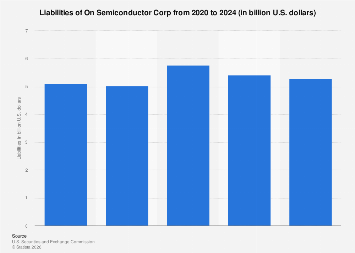
The semiconductor industry, a linchpin of the global digital economy, is characterized by rapid innovation, intense competition, and significant capital expenditure. Within this dynamic landscape, understanding the financial health and liabilities of key players like On Semiconductor Corporation (ON Semiconductor) is paramount for investors, analysts, and industry stakeholders. As of 2024, a detailed examination of ON Semiconductor’s liabilities offers crucial insights into its operational resilience, strategic positioning, and future growth prospects. While specific, granular data often requires proprietary access, a comprehensive analysis of the typical liabilities faced by a company of ON Semiconductor’s scale, coupled with market trends, provides a robust framework for understanding its financial commitments.
Liabilities, in financial accounting, represent obligations arising from past transactions or events, the settlement of which is expected to result in an outflow of resources. For a global semiconductor manufacturer, these liabilities typically fall into several broad categories: current liabilities and non-current liabilities. Current liabilities are those expected to be settled within one year, such as accounts payable, short-term debt, accrued expenses, and deferred revenue. Non-current liabilities, conversely, are obligations due beyond one year, including long-term debt, deferred tax liabilities, and pension obligations.
Accounts payable represent the money owed by ON Semiconductor to its suppliers for goods and services purchased on credit. In a complex supply chain like that of semiconductors, where raw materials, components, and manufacturing services are procured from numerous global entities, managing accounts payable efficiently is critical for maintaining supplier relationships and ensuring uninterrupted production. The volume and timing of these payments directly impact the company’s working capital. Given the fluctuating demand and lead times inherent in the semiconductor market, ON Semiconductor’s ability to forecast and manage its payables effectively can be a significant determinant of its operational smoothness.
Short-term debt, if any, would encompass borrowings due within the next twelve months. This might include revolving credit facilities or short-term loans used to manage seasonal fluctuations in inventory or working capital needs. The cost of this debt, influenced by prevailing interest rates, directly affects the company’s profitability. In the current economic climate, where interest rates have seen significant adjustments globally, the cost of short-term financing is a crucial factor for companies to monitor.
Accrued expenses are costs incurred but not yet paid. For a manufacturing entity, this can include salaries and wages payable, rent, utilities, and accrued interest on any outstanding debt. The accurate recognition and estimation of these expenses are vital for a true and fair representation of the company’s financial position. Deferred revenue, on the other hand, represents payments received for goods or services that have not yet been delivered or rendered. In the semiconductor sector, this could arise from long-term supply agreements where customers make advance payments for future chip deliveries.
Long-term debt is a significant component of a capital-intensive industry like semiconductors. ON Semiconductor, like many of its peers, likely utilizes long-term debt to finance substantial investments in research and development, manufacturing capacity expansion, acquisitions, and capital equipment. This debt could take the form of corporate bonds, term loans, or other financing arrangements. The total amount of long-term debt, its interest rates, and its maturity profile are key indicators of the company’s financial leverage and its ability to service its obligations over an extended period. High levels of long-term debt can increase financial risk, especially during economic downturns or periods of rising interest rates, as it places a greater burden on cash flow to meet principal and interest payments.
Deferred tax liabilities represent income taxes payable in future periods. These arise due to differences between accounting rules and tax regulations, often related to depreciation of assets or timing of revenue and expense recognition. For a multinational corporation like ON Semiconductor, with operations across various tax jurisdictions, managing deferred tax liabilities is a complex undertaking, influenced by differing tax rates and regulations.
Pension obligations, though less prevalent in some regions due to the shift towards defined contribution plans, can still represent a material liability for companies with defined benefit pension plans. These obligations are sensitive to changes in actuarial assumptions, such as employee life expectancy and discount rates, and can require significant funding.
The 2024 landscape for ON Semiconductor’s liabilities is shaped by broader macroeconomic forces and industry-specific trends. Global inflation, while showing signs of moderation in some economies, continues to exert pressure on input costs, potentially increasing accounts payable and accrued expenses. Interest rate policies of major central banks remain a critical determinant of the cost of both short-term and long-term borrowing. Geopolitical uncertainties and supply chain disruptions, which have been persistent themes in recent years, can also impact liabilities through extended payment terms, increased inventory holding costs, and potential penalties for delayed deliveries.
From an industry perspective, the ongoing demand for advanced semiconductors across sectors like automotive, industrial automation, artificial intelligence, and consumer electronics fuels ON Semiconductor’s revenue growth. However, this demand is often cyclical, necessitating careful management of production capacity and inventory, which in turn impacts working capital requirements and related liabilities. Investments in next-generation technologies, such as advanced packaging, new materials, and specialized chip architectures, require substantial capital outlay, often financed through a combination of equity and debt. This ongoing investment cycle means that managing debt levels and associated interest expenses remains a strategic priority.
Comparatively, ON Semiconductor operates within a highly competitive global market. Companies like Taiwan Semiconductor Manufacturing Company (TSMC), Intel, and Samsung Electronics are also significant players, each with its own distinct liability profile shaped by their scale, operational strategies, and geographic footprints. For instance, TSMC’s massive foundry business model and its focus on cutting-edge manufacturing might entail different liability structures compared to ON Semiconductor’s diversified product portfolio and fabless or fab-lite operational aspects. Analyzing these liabilities in the context of industry peers helps to gauge ON Semiconductor’s financial discipline and its ability to generate returns relative to its risk profile.
The economic impact of managing these liabilities is profound. A company with well-managed liabilities is better positioned to weather economic downturns, attract investment, and pursue strategic growth opportunities. Conversely, excessive or poorly managed liabilities can constrain a company’s financial flexibility, increase its vulnerability to market shocks, and potentially lead to credit rating downgrades, making future borrowing more expensive. For ON Semiconductor, its ability to optimize its liability structure—balancing the need for financing growth with the imperative of maintaining financial stability—is a continuous strategic challenge. The company’s financial reporting, particularly its balance sheet and cash flow statements, provides essential data points for this analysis, allowing stakeholders to assess the composition and trends of its obligations. As the semiconductor industry continues its transformative journey, a keen eye on the financial commitments of key players like ON Semiconductor remains indispensable for understanding the sector’s economic trajectory.