
Ukraine’s financial sector has demonstrated remarkable resilience and adaptability in the face of relentless conflict, a testament to a strategic blend of rapid digital transformation, decisive regulatory action, and robust international cooperation. Despite the pervasive challenges of physical infrastructure damage, energy disruptions, and the constant threat of cyber warfare, the country’s banking, insurance, and broader financial services have not only endured but have also laid the groundwork for future stability and growth. This sustained operational capacity, often achieved under extreme duress, highlights a significant shift in the nation’s economic landscape, accelerating its embrace of Western-style modernization.
The immediate operational challenges presented by the full-scale invasion were formidable. Ensuring staff safety, maintaining communication lines, and protecting physical assets became daily concerns. Russian attacks deliberately targeted critical infrastructure, leading to widespread power outages and communication blackouts. Furthermore, the financial institutions faced a heightened risk of sophisticated cyberattacks. In response, many Ukrainian firms have developed some of the world’s most advanced cybersecurity protocols, driven by necessity. The resilience of the financial system has been recognized globally, with the Organisation for Economic Co-operation and Development (OECD) noting Ukraine’s strong performance. A recent OECD report highlighted that "Three years into Russia’s war of aggression, Ukraine continues to show strong resilience. Despite the ongoing hostilities, policy makers and regulators are continuing to work hard to ensure the stability and resilience of the financial system, and to support households and businesses. At the same time, they are progressing reforms to increase transparency, accountability, and efficiency in the regulatory framework for financial markets and corporate governance, in line with international standards and in partnership with multilateral organisations and partner countries." This stability is underpinned by an impressive story of operational innovation, particularly the swift pivot to digital platforms for customer engagement and service delivery, a development that has become a source of national pride.

The war acted as a powerful catalyst for digitisation across Ukrainian society and business, building upon pre-existing efforts to shed Soviet-era bureaucratic legacies. Olena Sotnyk, Managing Director of Rasmussen Global Ukraine and a policy advisor to Ukraine’s Deputy Prime Minister for European Integration, observed at a recent London event that even traditionally conservative institutions readily embraced rapid change. "I can see, because I work in this area, how even very old style institutions are ready to change quickly. They are ready to sacrifice their business-as-usual [models] and that has created momentum for Ukraine to switch from the heritage of Soviet Union legacy to a really western model," she stated. This digital acceleration has yielded services and efficiencies that, in some aspects, surpass those found in more established European markets. "We already have something which even the European Union doesn’t have with digitalisation as that has helped to digitalise the whole country, because when you can’t physically get services or when you can’t physically get documents, approvals etc, you look for more efficient ways in how to do that. Digitalisation is one of the answers we have."
However, the initial shock of the invasion in February 2022 caused significant dislocation. Alina Golubieva, CEO and Co-founder of Karpatia Benefits, a financial advisory and insurance firm based in Kyiv, recounted the profound impact on their client base, which included firms with operations in heavily affected cities like Kharkiv, Kherson, and Mykolaiv, as well as Mariupol. "We had a few clients in Kharkiv, we had clients in Kherson and in Mykolaiv, which wasn’t invaded, but still badly affected. And we had a lot of clients with employees in Mariupol as well. So basically, they relocated to either other parts, or we just saw the numbers there drop drastically," Golubieva explained. She cited an example of a client with approximately 600 employees in Kharkiv, which has since dwindled to 50, with others relocated within Ukraine or abroad.
Despite the immense disruption, Karpatia Benefits experienced a significantly lower portfolio loss than anticipated. "We were expecting to lose about 80 percent of our portfolio, but we lost only 30 percent because we haven’t stopped working and we are a digital business. Every day we were online and we were answering clients’ questions," Golubieva stated, emphasizing the crucial role of their digital infrastructure and the team’s swift response. "It was an amazing team effort. On February 24, 2022 we regrouped quickly. Some of our people relocated to safer areas of Ukraine if they were able to. We didn’t store any paper-based agreements or anything like that. So we closed the office for two months and it didn’t affect our work at all." The firm’s focus on the IT sector also proved advantageous, as many of these companies were able to establish operational hubs in neighboring European countries like Poland, Spain, and Germany.

The successful navigation of this crisis was intrinsically linked to fundamental adjustments in regulatory frameworks and the sustained flow of capital, signifying a rapid re-engineering of Ukraine’s entire financial ecosystem. The National Bank of Ukraine (NBU) immediately placed the banking system on a war footing, implementing stringent capital flow controls and restrictions on foreign exchange outflows. Concurrently, the NBU relaxed certain regulations concerning loan forbearance and grace periods, encouraging necessary loan restructurings. This proactive stance was part of a broader, ongoing transformation of Ukraine’s banking sector, which had been fragmented and undercapitalized in the aftermath of the 2014 Revolution of Dignity. At the commencement of the war, 71 banks operated in Ukraine, including five controlled by Russian interests. Alfa Bank, a significant player with a 3.2 percent market share, was nationalized in July 2023 by the NBU due to its persistent ownership ties to Russia.
The insurance sector also experienced significant shifts, particularly with the withdrawal of firms identified as having Russian control. Providna, a major Ukrainian insurer, had its license revoked by the NBU in March 2023 for failing to provide necessary beneficiary information to regulators, alongside Ingosstrakh, another Russian-controlled entity. The insurance subsidiary of Alfa Bank also faced license cancellation. In total, 23 insurers exited the Ukrainian market as the NBU accelerated plans to enhance capital requirements, driven by concerns over the viability of firms potentially facing escalating losses.
While increased state involvement in the banking sector has provided a crucial layer of stability, its long-term implications will require careful consideration post-war. Alexander Pivovarsky and Ralph De Haas of the European Bank for Reconstruction and Development (EBRD) noted in a report for the Centre for Economic Policy Research that "Deepening Ukraine’s banking sector will require the privatisation of most of its main state lenders, which will account for an even greater majority of all banking assets after the war." They identified a critical challenge: "state banks remain reluctant to write off or restructure debt in a way that would reduce the value of any (collateralised) state assets. While there is no legal restriction on financial restructuring by state banks, in practice the perception is that any loan restructuring that entails a (partial) write-off may be challenged by law enforcement agencies and considered as misappropriation or damage to state property."
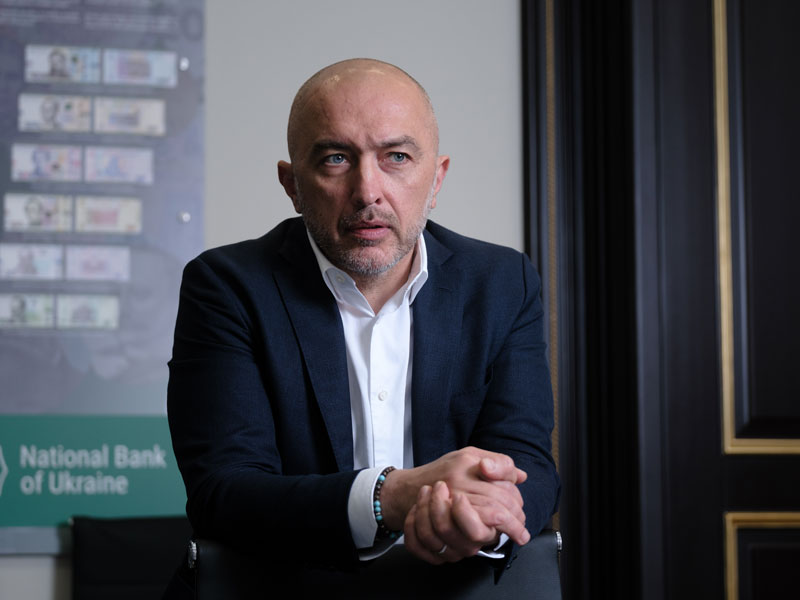
To ensure continued access to banking services, particularly during periods of power outages, the NBU launched the "Power Banking" initiative, spearheaded by NBU Governor Andriy Pyshnyy. He described the initiative to the International Monetary Fund as "the creation of one network of branches of systematically important banks in Ukraine. We are talking about over 1,000 branches in 200 cities and villages. These branches are expected to function as one network. We are developing operational solutions to support this network, even under blackout conditions, with backup electricity, connectivity, and cash. Nothing comparable has ever been implemented anywhere in the world." This initiative was complemented by a strategic effort to divest banks of software and systems developed by Russian or Belarusian companies, bolstering resilience against anticipated cyber threats. Investing in Ukraine’s established IT sector was prioritized to facilitate this technological transition. The "Power Banking" initiative is now evolving into a long-term program focused on financial inclusion, aiming to provide services to residents and small businesses in frontline and re-occupied regions by enabling large retail and postal service companies with branch networks to obtain limited banking licenses.
International support has been instrumental in bolstering Ukraine’s financial stability. In the first year of the war, the World Bank mobilized approximately $38 billion in emergency financing, commitments, and pledges, including grants, guarantees, and parallel financing from the United States, the United Kingdom, Canada, European nations, and Japan. This funding was critical in ensuring the timely payment of state pensions and salaries for public sector employees, with a target of 98.5 percent of pension payments being consistently met.
Meanwhile, mainstream commercial banks have continued to enhance their business resilience. The ratio of loans to bank assets has declined from 36 percent in December 2021 to 23.6 percent by early 2024, while liquid instruments, such as cash and deposits at the NBU, have risen from 27.1 percent to 43 percent during the same period, indicating a prevailing sense of caution and robust contingency planning. In August 2025, the Ukrainian Ministry of Finance unveiled a revised national financial sector development strategy, emphasizing the upgrade of capital markets infrastructure and the consolidation of accounting and trading systems to attract foreign investment. The strategy also commits the NBU to aligning its regulations with European Union standards and continuing efforts to enhance transparency and eradicate corruption, which the Ministry attributes in part to residual Russian influence.

Beyond governmental and institutional support, Western financial institutions have played a crucial role. Local insurers, facing challenges in accessing the international reinsurance market, received assistance through a scheme facilitated by US insurance broker Aon and the EBRD, benefiting three Ukrainian insurers: Ingo, Colonnade, and Uniqa. A specialized marine insurance package was also established to support grain shipments from Odesa, and new mechanisms for capital raising through global investment funds within the wholesale banking sector are under development. In March 2025, global reinsurer MS Amlin launched a reinsurance scheme capable of providing €1 billion in annual war risk cover to Ukrainian small and medium-sized enterprises (SMEs) insured by local Ukrainian insurers. This initiative aims to stimulate business activity in preparation for Ukraine’s post-war reconstruction. Following this, in August, the Ukrainian government and representatives from leading insurance companies, including Marsh McLennan, Aon, MS Amlin, Fairfax Insurance Group, and the National Association of Insurers of Ukraine, signed a memorandum of understanding in Rome to foster the development of the country’s insurance market. Yulia Svyrydenko, Ukraine’s First Deputy Prime Minister and Minister of Economy, who launched the memorandum, stated, "We are sending a clear signal: Ukraine is actively looking for ways to reduce risks for business. This memorandum demonstrates our common intention to form a modern insurance market with flexible products that will provide comfort to investors." These measures are considered vital prerequisites for attracting the substantial international finance required for Ukraine’s reconstruction.
The estimated reconstruction needs over the next decade are projected to reach $486 billion, a figure nearly three times Ukraine’s nominal GDP in 2023. As the conflict persists and Russian attacks on Ukrainian infrastructure intensify, these financial requirements are likely to escalate. A well-functioning capital markets infrastructure and robust financial institutions will be indispensable for attracting the necessary foreign investment and fostering domestic financial growth. Equally critical is the unwavering determination of the Ukrainian people to rebuild their nation. Despite the profound weariness of three protracted years of war, their belief in the country’s future remains resolute. When Alina Golubieva decided to re-establish a physical office presence in Kyiv, she chose a co-working space in the city center, located within a complex symbolically named "Nepemora," which translates to "Victory" in Ukrainian, a powerful embodiment of national resilience and aspiration.