


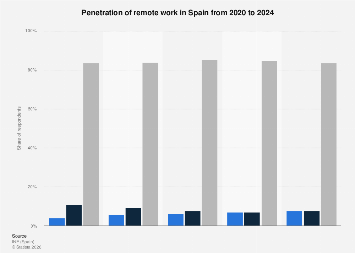
The modern Spanish workplace is undergoing a significant transformation, with a clear shift towards hybrid work arrangements becoming the dominant trend observed between 2020 and 2024. During this period, the proportion of the workforce engaged in hybrid models—combining remote and in-office duties—has seen a substantial climb, indicating a growing preference for flexible work structures. Conversely, the share of employees exclusively working from home has experienced a decline, suggesting that a full telecommuting setup is not the prevailing future for the majority of Spanish professionals.
Despite advancements in digital infrastructure, the widespread adoption of remote work faces persistent hurdles in Spain. Over the past decade, from 2014 to 2024, internet penetration in the country has surged, with the percentage of the population having access to the internet rising from a modest figure to nearly universal coverage. Concurrently, a vast majority of Spanish companies now possess internet access, a fundamental prerequisite for facilitating remote operations. However, a curious paradox emerges: a substantial segment of businesses that are technically capable of offering remote work options choose not to, and in many instances, they either provide no justification or are unable to articulate the reasons behind this decision. This suggests that beyond technological availability, other factors, perhaps cultural, operational, or management-related, are playing a crucial role in shaping remote work policies.
The question of equity in remote work opportunities within Spain reveals a nuanced picture. While gender parity appears to be a relatively positive aspect, with similar rates of individuals able to work from home reported for both men and women in recent years, economic disparities are more pronounced. Analysis of remote work incidence by household income demonstrates a clear correlation between higher earnings and greater access to telecommuting. In 2023, a significantly larger percentage of individuals from households earning €5,000 or more per month were able to work remotely compared to those in households with incomes below €1,500. This disparity underscores the potential for remote work to exacerbate existing economic inequalities, as those in lower-income brackets, often in roles less conducive to remote work or lacking the necessary home office setup, are left behind.
This trend is not unique to Spain. Globally, the post-pandemic era has witnessed a recalibration of work models. While countries like the United States and Canada have seen robust growth in hybrid and remote work, with some sectors embracing fully remote arrangements, many European nations are navigating similar challenges to Spain. The economic rationale for companies to embrace remote or hybrid work is often tied to potential cost savings on office space, access to a wider talent pool, and increased employee satisfaction and productivity. However, concerns about maintaining company culture, ensuring effective collaboration, managing cybersecurity risks, and providing equitable access to technology and support for all employees remain critical considerations for businesses worldwide.
In Spain, the data points towards a growing acceptance of flexibility, but not necessarily a complete detachment from the physical office. The increasing prevalence of hybrid models suggests a desire among both employees and employers to find a balance that harnesses the benefits of remote work—such as reduced commute times and improved work-life balance—while retaining the advantages of in-person interaction, team cohesion, and spontaneous collaboration. The reluctance of some companies to adopt remote work, even when technically feasible, could stem from a variety of factors including deeply ingrained organizational cultures that value presenteeism, a lack of trust in remote employees, the perceived complexity of managing distributed teams, or a belief that certain roles inherently require physical presence.
Economically, the implications of these evolving work patterns are far-reaching. For urban centers, a sustained shift towards hybrid work could lead to reduced demand for prime office real estate, impacting commercial property values and the ancillary businesses that support office life, such as restaurants, cafes, and retail outlets. Conversely, it could spur investment in and revitalization of suburban and rural areas as individuals seek more affordable housing and a better quality of life, further from traditional business districts. The digital divide, highlighted by the income disparity in remote work access, also presents an economic challenge. Ensuring that all segments of the population have the digital literacy and connectivity to participate in the future of work is crucial for inclusive economic growth and social mobility.
Furthermore, the policy implications are significant. Governments and regulatory bodies are increasingly tasked with establishing frameworks that support flexible work arrangements while protecting employee rights and ensuring fair labor practices. This includes considerations around the right to disconnect, reimbursement for home office expenses, and provisions for mental health and well-being for remote workers. The Spanish government, like many others, is likely monitoring these trends closely to understand their impact on productivity, employment, and broader economic development.
The future of work in Spain, as indicated by the 2024 data, is not a simple binary of office versus home. Instead, it is a dynamic spectrum where hybrid models are emerging as the most practical and popular solution for a significant portion of the workforce. The challenge lies in bridging the gap between technological capability and organizational adoption, and in ensuring that the benefits of this evolving work landscape are shared equitably across all socioeconomic strata. As businesses continue to adapt and workers’ expectations shift, the ongoing evolution of the Spanish workplace will undoubtedly remain a key area of focus for economic analysts and policymakers alike. The persistence of traditional work structures in some sectors, alongside the embrace of new flexibilities in others, paints a complex but ultimately forward-looking picture of how Spain is redefining its professional environments.