


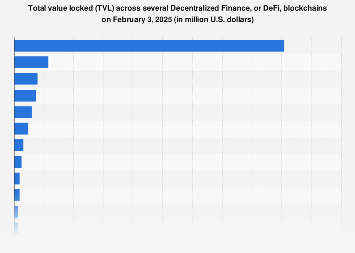
As of September 5, 2025, the decentralized finance (DeFi) ecosystem continues its dynamic evolution, with Ethereum solidifying its position as the undisputed leader in Total Value Locked (TVL). TVL, a critical metric representing the aggregate value of assets deposited into DeFi protocols, serves as a close proxy for the overall market size and health of the decentralized financial landscape. Ethereum’s dominance is not merely incremental; its TVL dwarfs that of all other blockchains combined, underscoring its foundational role in powering the vast majority of DeFi transactions and applications.
The trajectory of the DeFi market has been nothing short of spectacular, particularly throughout 2021, when it experienced unprecedented growth, reaching new heights. This surge was intrinsically linked to the performance of Ethereum, the primary blockchain infrastructure underpinning this burgeoning sector. Fluctuations in the price of Ether (ETH), Ethereum’s native cryptocurrency, therefore, exert a significant influence on the DeFi market. For instance, a notable overnight price drop in ETH on September 10, 2021, resulted in a substantial decline of over [masked value] billion U.S. dollars in Ethereum’s TVL, illustrating the profound correlation between the underlying asset’s value and the capital locked within its DeFi ecosystem.
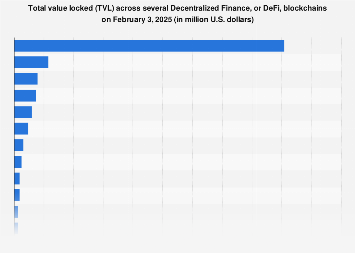
While Ethereum commands the lion’s share, a diverse array of other blockchains are actively participating and growing within the DeFi space. These alternative networks, often referred to as "Ethereum competitors" or "Layer 2 solutions," are vying for market share by offering distinct advantages such as lower transaction fees, faster processing times, or specialized functionalities. As of February 3, 2025, data indicates a substantial amount of value locked across several of these prominent blockchains, though still a fraction of Ethereum’s total. Understanding the distribution of TVL across these various platforms provides crucial insights into the competitive landscape and the potential for future diversification within DeFi.
The landscape of blockchain platforms hosting DeFi protocols is multifaceted, with each presenting a unique value proposition. Besides Ethereum, significant players include Binance Smart Chain (now BNB Chain), Solana, Cardano, Avalanche, Polkadot, and Polygon, among others. Each of these networks has attracted substantial developer activity and user adoption, fostering vibrant ecosystems of decentralized applications (dApps) ranging from decentralized exchanges (DEXs) and lending protocols to yield farming platforms and stablecoin issuers. The competition among these blockchains is driving innovation, pushing the boundaries of what is possible in decentralized finance and offering users a broader spectrum of choices.
BNB Chain, for example, has leveraged its strong ties to the Binance cryptocurrency exchange to attract a large user base and significant liquidity. Its lower transaction costs compared to Ethereum’s mainnet have made it an attractive option for retail users and high-frequency trading strategies. Solana, on the other hand, has gained traction with its high-throughput, proof-of-stake consensus mechanism, enabling exceptionally fast transaction speeds and low fees, which are particularly beneficial for applications requiring rapid state changes, such as decentralized derivatives or gaming.
Cardano, with its research-driven approach and focus on security and sustainability, has been steadily building its DeFi ecosystem. Its peer-reviewed development process aims to ensure a robust and reliable foundation for decentralized applications. Avalanche has distinguished itself through its unique architecture, comprising three interoperable blockchains, which allows for high scalability and customization, attracting a growing number of DeFi projects. Polkadot and its parachains offer a modular approach, enabling specialized blockchains to interoperate and share security, fostering a more interconnected and flexible DeFi landscape. Polygon, a prominent Layer 2 scaling solution for Ethereum, provides a framework for building and connecting Ethereum-compatible blockchain networks, offering reduced fees and faster transactions without compromising on security.
The growth of TVL on these alternative blockchains is not just a testament to their technological capabilities but also reflects a broader trend of decentralization within the DeFi space. As the Ethereum network continues to grapple with scalability challenges and high gas fees, users and developers are actively exploring and migrating to platforms that offer more cost-effective and efficient solutions. This migration, however, does not necessarily signify a decline in Ethereum’s importance. Instead, it highlights the maturation of the DeFi market, where increased competition and specialization are leading to a more robust and resilient overall ecosystem.
Furthermore, the emergence of Layer 2 scaling solutions built on top of Ethereum, such as Optimistic Rollups and ZK-Rollups, is playing a crucial role in alleviating network congestion and reducing transaction costs. These solutions allow for a significantly higher number of transactions to be processed off-chain while still inheriting the security guarantees of the Ethereum mainnet. As these Layer 2 technologies mature and gain wider adoption, they are expected to further enhance the scalability and accessibility of DeFi applications built on Ethereum, potentially mitigating the need for a complete migration to alternative Layer 1 blockchains for many use cases.
The economic implications of this evolving DeFi landscape are substantial. Increased TVL across various blockchains signifies a growing pool of capital being allocated to decentralized financial services, offering alternatives to traditional financial intermediaries. This can lead to greater financial inclusion, enabling individuals who may be underserved by conventional banking systems to access a wider range of financial products and services. Moreover, the innovation driven by competition in the DeFi space can spur the development of new financial instruments and business models, potentially leading to increased efficiency and reduced costs across the financial sector.
However, the rapid growth and inherent complexity of DeFi also present significant risks. Volatility in cryptocurrency prices, smart contract vulnerabilities, regulatory uncertainty, and the potential for systemic risk are all critical considerations for investors, developers, and policymakers alike. The interconnectedness of DeFi protocols means that a failure in one component could have cascading effects throughout the ecosystem. Therefore, robust risk management strategies, thorough security audits, and a clear understanding of the underlying technologies are paramount for navigating this dynamic market.
Looking ahead, the trend of increasing TVL across a diverse range of blockchains, with Ethereum retaining its leadership position, is likely to continue. The interplay between Ethereum’s established network effects and the innovation offered by newer, more scalable blockchains will shape the future of decentralized finance. The ongoing development of Layer 2 solutions on Ethereum will also play a pivotal role in enhancing its scalability and competitiveness. As the DeFi ecosystem matures, we can expect to see greater specialization among blockchains, with different networks catering to specific use cases and user needs. This will foster a more robust, diverse, and ultimately, more impactful decentralized financial future, offering a compelling alternative to the traditional financial system.