


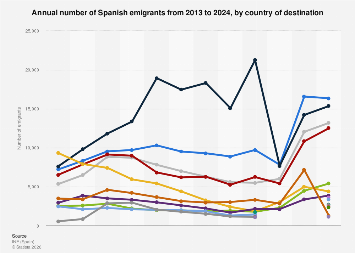
Spain, a nation historically characterized by significant waves of both immigration and emigration, is once again a focal point for understanding contemporary population flows. As of 2024, the patterns of Spanish citizens leaving the country offer a nuanced perspective on economic conditions, professional opportunities, and lifestyle preferences that are driving these outward movements. While precise, granular data on specific destination countries for departing Spaniards often requires specialized access, the overarching trends reveal a dynamic interplay between domestic challenges and the allure of international prospects.
The phenomenon of emigration from Spain is not a monolithic event but rather a multifaceted outflow influenced by a confluence of socio-economic factors. For decades, Spain has experienced periods of substantial outward migration, particularly during economic downturns, when job scarcity and limited career advancement prospects compelled many, especially younger generations, to seek opportunities abroad. Conversely, periods of robust economic growth have often seen a reversal, with Spain becoming a magnet for foreign workers. The current emigration patterns in 2024 are, therefore, best understood within this historical context, reflecting a recalibration of national appeal and global accessibility.
While a comprehensive breakdown of emigration destinations for 2024 remains under embargo for detailed statistical analysis, broader trends and anecdotal evidence point towards a continued, and in some cases, an intensified, interest in specific regions and countries. Historically, neighboring European nations have been primary destinations for Spanish emigrants due to geographical proximity, cultural affinities, and often, a shared language or at least linguistic ease of integration. Countries like France, Germany, the United Kingdom (prior to its exit from the European Union, and still relevant for many due to established networks), and Italy have consistently featured among the top choices. These destinations offer diverse labor markets, from highly skilled sectors in Germany and the UK to service and agricultural roles in France and Italy. The presence of established Spanish communities also provides a crucial support network for new arrivals, easing the transition and reducing the perceived risks of relocation.
Beyond immediate European neighbors, the allure of countries with rapidly expanding economies or specific industry strengths continues to draw Spanish talent. Latin America, with its deep cultural and linguistic ties, remains a significant, albeit often less formally tracked, destination. Countries like Mexico, Argentina, and Colombia offer opportunities in sectors such as technology, education, and entrepreneurship, appealing to those seeking to leverage their Spanish heritage and language skills. The economic development and growing middle class in these regions present a fertile ground for skilled professionals and investors.
Furthermore, the global demand for specialized skills, particularly in STEM fields (Science, Technology, Engineering, and Mathematics), is a potent driver of Spanish emigration. Nations like Canada and Australia, with their points-based immigration systems that prioritize skilled workers, are increasingly attractive. These countries not only offer robust employment prospects but also often present a higher quality of life, better social services, and more stable economic environments compared to some domestic or even European alternatives. The prospect of long-term residency and citizenship further enhances their appeal for those looking to establish roots abroad.
The United States, with its vast and diverse economy, continues to attract Spanish emigrants, particularly those with specialized skills in fields like finance, technology, and academia. While immigration policies can be complex, the sheer scale of opportunities and the presence of leading global corporations make it a perennial destination for ambitious individuals.
Economic factors undoubtedly play a central role in shaping these emigration trends. While Spain has seen periods of economic recovery, persistent challenges such as youth unemployment, particularly in certain regions, and wage stagnation in some sectors can push individuals to seek more lucrative or stable career paths elsewhere. The global economic landscape, marked by the ongoing digital transformation and the rise of new economic powerhouses, creates a competitive environment where skilled workers are in high demand worldwide. Spanish graduates and experienced professionals, equipped with strong educational backgrounds and linguistic capabilities, are well-positioned to capitalize on these international opportunities.
Statistics on Spanish emigration are often fragmented, with different methodologies employed by various national and international bodies. However, available data from Eurostat and national statistical institutes, when accessible, consistently highlight a correlation between economic downturns in Spain and increased emigration. For instance, following the 2008 financial crisis, Spain witnessed a notable surge in its citizens moving abroad. While the scale of emigration in the post-pandemic era of 2024 may differ, the underlying drivers remain potent.
The demographic profile of emigrants is also noteworthy. Younger individuals, typically between the ages of 20 and 35, constitute a significant portion of those leaving Spain. This demographic is often at a crucial stage in their careers, seeking to gain international experience, advance professionally, and build financial security. The decision to emigrate is frequently influenced by a desire for personal and professional growth that may be perceived as more readily attainable outside of Spain’s current economic climate.
The impact of this ongoing emigration on Spain’s economy and society is a subject of ongoing debate and analysis. On one hand, the departure of skilled workers, often referred to as "brain drain," can represent a loss of human capital and potential innovation for the domestic economy. These individuals, having benefited from Spain’s educational system, are contributing their talents and tax revenues to other nations. Furthermore, a reduction in the working-age population can have long-term implications for social security systems and economic growth.
On the other hand, emigration can also yield positive returns. Remittances sent back by emigrants can provide a significant source of income for families in Spain, boosting consumption and supporting local economies. Moreover, returning emigrants often bring back valuable international experience, new skills, and entrepreneurial ideas that can benefit Spain upon their eventual repatriation. The establishment of global networks by Spanish emigrants can also foster business collaborations and trade links between Spain and their host countries.
Understanding the precise destinations and motivations behind Spanish emigration in 2024 requires continued monitoring of statistical trends and qualitative research. However, the available insights suggest a persistent outward flow driven by a combination of economic imperatives, career aspirations, and the global search for opportunity. As Spain navigates its current economic landscape, the patterns of its citizens seeking their fortunes abroad will continue to be a critical indicator of its competitiveness and its place within the interconnected global economy. The ongoing flow of talent underscores the importance of policies aimed at retaining skilled professionals, fostering domestic job creation, and ensuring that Spain remains an attractive place to live, work, and thrive.