


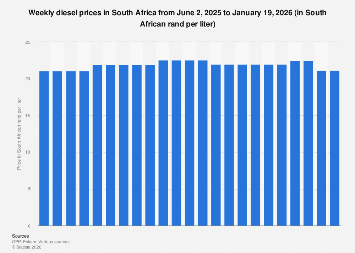
As of January 19, 2026, the retail price for diesel fuel in South Africa registered at a significant level, equivalent to approximately [masked value] U.S. dollars per liter. This figure places South Africa among the nations experiencing notably higher diesel costs on the global stage, according to recent market data. The weekly price tracking, spanning from June 2, 2025, to January 19, 2026, reveals a consistent trend of elevated prices for this critical commodity. The provided data, referencing retail pump prices inclusive of all taxes and fees, underscores the substantial cost burden faced by consumers and businesses reliant on diesel for transportation and industrial operations.
The average diesel price in South Africa during the surveyed period, when converted to U.S. dollars using the exchange rate of 1 USD to 16.39 ZAR as of January 19, 2026, indicates a premium compared to many international markets. While specific weekly figures are masked, the overall positioning suggests a complex interplay of global oil market dynamics, domestic fuel pricing mechanisms, and currency fluctuations. Understanding these factors is crucial for businesses operating within South Africa’s economic landscape, as fuel costs directly impact logistics, manufacturing, agriculture, and ultimately, consumer inflation.
Navigating the Global Diesel Landscape
South Africa’s high diesel price ranking is not an isolated phenomenon but rather a reflection of broader global trends that impact energy markets. The price of crude oil, the primary feedstock for diesel, is subject to geopolitical tensions, supply and demand imbalances, and the production decisions of major oil-exporting nations. Fluctuations in the Brent crude oil benchmark, for instance, have a direct and immediate effect on the cost of refined products like diesel worldwide.
Furthermore, the strength or weakness of a nation’s currency plays a pivotal role in determining the landed cost of imported commodities. For South Africa, a depreciating Rand against the U.S. dollar, the currency in which crude oil is predominantly traded, inherently increases the cost of fuel imports. This currency effect can exacerbate the impact of rising global oil prices, pushing domestic fuel prices even higher.
The structure of fuel taxation within South Africa also contributes to the retail price. Value Added Tax (VAT), the Fuel Levy, and the Road Accident Fund (RAF) levy are significant components that add to the final price consumers pay at the pump. While these levies are intended to fund essential public services and infrastructure, their cumulative impact on fuel affordability is a recurring point of discussion and concern for economic stakeholders.
Economic Implications for South Africa
The elevated cost of diesel has far-reaching economic consequences for South Africa. For the transportation sector, which forms the backbone of trade and commerce, higher diesel prices translate directly into increased operating costs for trucking companies, public transport operators, and logistics providers. These costs are often passed on to consumers in the form of higher prices for goods and services, contributing to inflationary pressures.
The agricultural sector, heavily reliant on diesel-powered machinery for planting, harvesting, and transportation, faces a significant challenge. Increased fuel expenses can erode profit margins for farmers, potentially leading to higher food prices and impacting food security. Similarly, industries that depend on diesel for power generation or as a critical input in their production processes will experience higher overheads, potentially affecting their competitiveness in both domestic and international markets.
Moreover, the South African economy is characterized by a high degree of inequality. Rising fuel prices disproportionately affect lower-income households, who spend a larger percentage of their income on essential goods and services, including transportation. This can exacerbate social and economic disparities.
Comparative Analysis: A Global Perspective
While precise comparative data on weekly diesel prices across all nations is complex to compile due to varying reporting standards and currency fluctuations, South Africa’s inclusion among the "highest" price brackets indicates a need for deeper analysis. Typically, countries with high fuel taxes, significant import reliance, or weaker currencies tend to exhibit higher diesel prices.
In contrast, nations that are net oil exporters, possess robust refining capacities, or offer substantial fuel subsidies may experience lower diesel costs. For example, countries in the Middle East, often major oil producers, typically have significantly lower fuel prices. Similarly, some developed economies, while experiencing their own price pressures, may benefit from more stable currencies or diversified energy portfolios that can buffer against extreme price volatility.
The International Energy Agency (IEA) and other global energy watchdogs frequently publish reports that highlight price differentials across regions. These reports often point to the influence of government policies, the efficiency of energy markets, and the level of infrastructure development as key determinants of fuel affordability. South Africa’s situation suggests that while global market forces are at play, domestic factors, including taxation and currency management, are significant contributors to its current diesel price levels.
Future Outlook and Policy Considerations
The outlook for diesel prices in South Africa remains intrinsically linked to global oil market trajectories and domestic economic conditions. Geopolitical events, such as conflicts in oil-producing regions or significant policy shifts by major energy players, could lead to further price volatility. Domestically, the performance of the South African Rand and government fiscal policies regarding fuel levies and taxes will be critical determinants of future price movements.
Policymakers face a delicate balancing act. On one hand, they must ensure the affordability of essential commodities like diesel for the broader population and the functioning of key economic sectors. On the other hand, fuel levies often contribute vital revenue for public infrastructure and services. Exploring avenues for greater fuel price stability, such as strategic petroleum reserves, diversification of energy sources, or targeted support for vulnerable sectors, may become increasingly important.
The transition towards cleaner energy sources also presents a long-term consideration. While diesel remains a crucial fuel for the foreseeable future, investments in renewable energy, electric vehicle infrastructure, and more fuel-efficient technologies could gradually reduce the economy’s reliance on fossil fuels, potentially mitigating the impact of diesel price volatility over the long run. The current elevated prices serve as a stark reminder of the energy security challenges and economic vulnerabilities that South Africa, like many nations, continues to navigate in the globalized energy landscape.