



The mid-2010s heralded a period of unprecedented growth for Europe’s financial technology sector. A new wave of innovative companies began to redefine the very fabric of consumer banking, with burgeoning fintech firms rapidly eclipsing traditional lenders in terms of valuation and media attention. This era saw record capital injections into the sector; venture capital funding surged from $19.4 billion in 2015 to $33.3 billion by 2020, a testament to the transformative potential of these digital disruptors, as highlighted in a report by McKinsey & Company. While the initial feverish pace has moderated in recent years, one company continues to embody the boundless ambition of its early days: Revolut, the app-based banking giant and current frontrunner in European fintech valuations.
Revolut has successfully navigated the challenging transition from startup to unicorn, and now to a profitable enterprise. In the fiscal year 2024, the company more than doubled its profits, reaching an impressive £1 billion. This financial milestone is paralleled by a significant surge in its user base, which has now climbed to 65 million customers. This trajectory suggests that the strategic vision of Revolut’s CEO and co-founder, Nikolay Storonsky, is yielding substantial results.
Established in 2015, Revolut’s genesis was as a prepaid card offering seamless, low-cost currency exchange. Over time, the company has undergone extensive experimentation across various financial verticals. Alongside the steady expansion of its core banking operations, Revolut now provides an expansive suite of services, ranging from cryptocurrency trading to integrated eSIMs for international travelers. Storonsky himself has articulated a grand vision: to create the "Amazon of banking." This "jack of all trades" philosophy, however, is underpinned by Storonsky’s expectation that Revolut will not merely offer a wide array of services but excel in each one.
Despite Revolut’s undeniable achievements to date, securing global banking dominance remains a complex undertaking. The acquisition of banking licenses has proven to be a protracted and challenging process for many fintechs. Furthermore, as is often the case with rapidly scaling technology companies, Revolut has faced scrutiny regarding its corporate culture, with former employees reporting demanding work environments. Adding to this complexity, a recent secondary share sale propelled the company’s valuation to an astonishing $75 billion, a significant leap from $45 billion the previous year, prompting some industry observers to question the sustainability of such a high valuation.
Undeterred, Storonsky continues to set his sights on ambitious goals, focusing on sustained innovation within new product areas and aggressive geographic expansion. The crucial question remains: does he possess the acumen and strategic foresight to build the world’s preeminent financial services provider?
The Genesis of Disruption
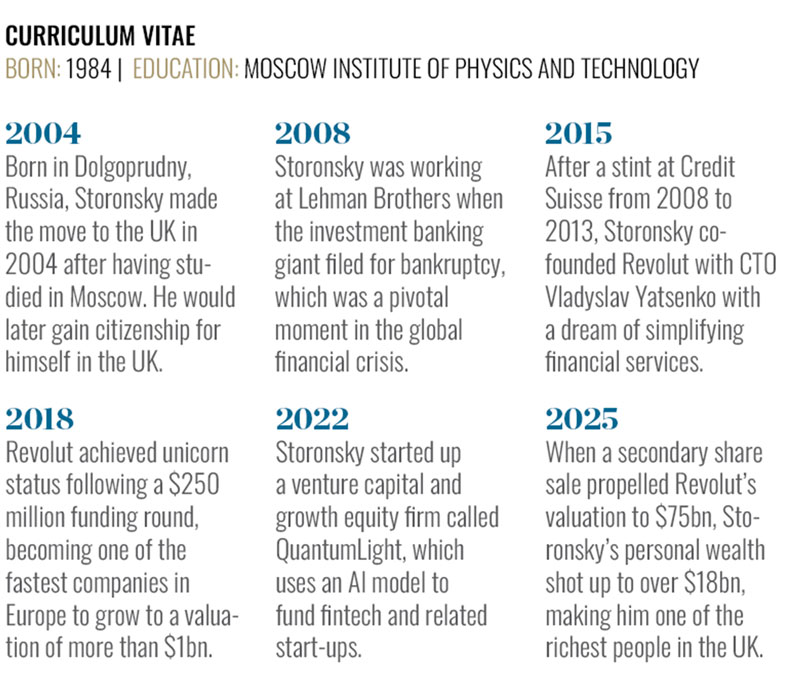
The seismic collapse of Lehman Brothers in 2008 sent profound shockwaves throughout the global financial services industry. For Nikolay Storonsky, this event proved to be a significant personal catalyst. A native of Russia, Storonsky relocated to the UK in 2004, armed with a degree in general and applied physics from the Moscow Institute of Physics and Technology and a further qualification in applied economics and finance from Moscow’s New Economic School. He soon joined a prominent lender as a derivatives trader. The bankruptcy of Lehman Brothers, a titan of the investment banking world, came as a profound shock. "It was a big and powerful investment bank, so the announcement came as a shock," Storonsky recounted to CNBC. "We were told without much warning, and it seemed to happen quite quickly."
This crisis, which reportedly cost Storonsky approximately half a million pounds, instilled in him a deep appreciation for data-driven decision-making and logical rigor. After a tenure at Credit Suisse from 2008 to 2013, Storonsky began to conceptualize a more streamlined approach to financial services. His idea was to develop an intuitive mobile application that would significantly reduce the fees associated with foreign currency transactions. In 2015, this vision materialized with the co-founding of Revolut alongside Vladyslav Yatsenko, a British-Ukrainian software developer with prior experience at UBS and Deutsche Bank, who continues to serve as the company’s Chief Technology Officer.
Across the broader fintech landscape, similar disruptive innovations were taking root. The global financial crisis had eroded consumer trust in established banking institutions, fostering a fertile ground for a new generation of tech-centric digital banks. Companies like Germany’s N26 and Fidor, Brazil’s Nubank, and the United States’ Chime emerged alongside Revolut, promising enhanced convenience, superior user experiences, and the agility to adapt their offerings rapidly. Many of these ventures were founded by individuals disillusioned by the fallout of Lehman Brothers, individuals who, like Storonsky, yearned for a more robust and reliable financial system. As Storonsky himself observed, "A number of successful entrepreneurs rose from the ashes who were pretty disillusioned with the financial system."
A Calculated Bet on Innovation
Following its launch, Revolut experienced an exceptionally rapid growth trajectory. By 2018, a substantial cash injection of $250 million propelled the fintech’s valuation beyond the $1 billion mark, instantly establishing it as Britain’s first digital bank unicorn and one of Europe’s fastest-growing tech companies to achieve this status.

Even at that early stage, Storonsky signaled that Revolut’s journey was far from over. "Our focus, since we launched, has been to do everything completely opposite to traditional banks," he stated at the time. "We build world-class tech that puts people back in control of their finances, we speak to our customers like humans and we’re never afraid to challenge old thinking in order to innovate."
Storonsky’s critique of the established banking order was stark: "Banking has historically avoided disruptions by technology, but that is all about to change on a big scale." His ambitious vision for an alternative global banking ecosystem, where "Anyone in the world can just download the Revolut app and set up a local bank account to access any services they need," as he articulated to Business Insider in 2017, is fundamentally driven by a philosophy of continuous evolution. This is most powerfully embodied in Revolut’s dedicated "new bets" division, an engine for identifying and developing nascent revenue streams.
The "move fast and break things" ethos, popularized by Mark Zuckerberg, has long been a guiding principle for tech companies, and Revolut is no exception. The company is renowned for its ability to swiftly launch into new markets and service areas, ranging from mobile phone plans to loyalty-based air mile programs. These ventures possess the potential to become rapid profit centers. Cryptocurrency trading, for instance, proved to be a significant contributor to Revolut’s first annual profit in 2021, fueled by a surge in retail investor interest during the crypto boom.
"Nikolay Storonsky’s leadership of Revolut highlights how speed and adaptability can really define success in fintech," comments Ed Gibbins, co-founder and CEO of ChaseLabs, an AI sales development system. "His approach reflects a deep understanding of tech disruption: launch quickly, scale globally, and then refine using real user feedback. This ability to treat global markets as testing grounds means Revolut can adapt features faster than rivals and align its offerings closely with consumer demand."
Each "new bet" at Revolut typically originates with a lean team of approximately 10 individuals, often led by an employee with a strong entrepreneurial background, as detailed in reports by Sifted. These teams operate with a budget of roughly £2 million to £3 million, tasked with developing experimental products within tight timelines, often as short as 18 months, though many have been brought to market even more rapidly.
By outmaneuvering traditional banks and even many of its challenger peers, Revolut has cultivated an image of agility that strongly resonates with tech-savvy consumers, according to Gibbins. "The strategy of rapid feature deployment and constant iteration allows the company to test ideas across markets and double down on what works. This cycle of innovation and responsiveness has enabled Revolut to outpace competitors and strengthen its position as a leading player in global fintech," Gibbins adds.
Successful "new bets" are scaled aggressively, while underperforming initiatives are either refined, downscaled, or discontinued. To date, 45 "new bets" have been approved, with a portion still in the development pipeline, according to a Revolut spokesperson. This unit operates on a model inspired by venture capital, a domain familiar to Storonsky, who launched his own VC firm, QuantumLight, in 2022, utilizing an AI model to invest in fintech and related startups.
Revolut’s combination of agility and its comprehensive service offering are significant draws for its customer base. "Revolut’s rise has been driven by a clear focus on tech-savvy consumers who expect more than traditional banking can deliver," observes Michael Foote, founder of Quote Goat, an insurance comparison tool. "By combining everyday money management with trading and payments inside one app, the company positions itself as a lifestyle tool rather than a conventional bank. This multifunctional approach has given it strong appeal among younger customers who value speed, convenience, and variety without juggling multiple providers."
As of September 2025, Revolut reported surpassing 65 million customers globally. This success has translated into substantial financial gains for Storonsky, who is believed to hold approximately a 25 percent stake in the company. Forbes estimates his net worth at $7.9 billion.
Navigating Growth Pains
While Revolut can celebrate its escalating customer numbers and robust profitability, the company’s financial triumphs may mask underlying challenges that have impacted its reputation. The firm’s aggressive corporate culture, for instance, has faced considerable scrutiny in recent years, with numerous former employees alleging unachievable performance targets, unpaid overtime, and immense pressure.
For an extended period, Revolut’s demanding work culture was an open secret. "We are not about long hours – we are about getting shit done," Storonsky stated to Business Insider in 2017. "If people have this mentality, they work long hours because they want it."
Glassdoor, a prominent employer review platform, hosts thousands of reviews for Revolut. Despite an overall rating of 4.0 as of October 2025, recurring themes in employee feedback include a lack of work-life balance and a management prioritization of targets above all else. Nevertheless, many reviewers acknowledge that while the high-pressure environment at Revolut is not suited to everyone, some individuals thrive within its demanding conditions.
"No one is sitting there telling them they have to work long hours," Storonsky elaborated to Business Insider. "They are really motivated, really sharing the vision of where we want to go and as a result, they work long hours – they work at least 12 or 13 hours a day. All the key people, all the core team. A lot of people also work on weekends."
Since that interview, Storonsky has asserted that changes have been implemented. "We are a different company than we were two to three years ago," he remarked in a 2019 interview with Reuters. "We have learned lessons." However, as recently as 2023, the company established an internal team to monitor employee adherence to principles of inclusivity, approachability, and respect, aiming to foster a more "human" workplace culture, as reported by The Guardian.
Francesca Cassidy, editor at Raconteur, a business news website, has questioned the efficacy of such changes if they are not fundamentally driven from the top. "Storonsky wants Revolut to be the ‘Amazon of banking.’ In pursuing this objective, he works tirelessly and expects much the same from his colleagues. With such a dedicated, driven character at the helm, it is little wonder that Revolut’s culture has developed as it has," she wrote in an opinion piece.
Cassidy further noted that the company’s initiatives to revamp performance reviews and introduce recognition programs "do little to address the high-performance culture that seems to be the source of much of the negative feedback." She posed the pertinent question: "How can employees be expected to pour their energy into being pleasant, collaborative colleagues if they are overworked, under stress and burnt out?"
Beyond its internal culture, Revolut has for years contended with a protracted approval process for its full UK banking license. While the company secured an EU banking license via Lithuania in 2018, its application for a comprehensive UK license, following a three-year review, remained pending at the time of publication. The Bank of England had reportedly raised concerns regarding the startup’s capacity to maintain robust risk management controls amidst its rapid international expansion, according to reports in the Financial Times.
Storonsky has acknowledged that not prioritizing the acquisition of a full UK banking license in Revolut’s early stages, opting instead for aggressive growth, was a strategic misstep. Obtaining this license would empower Revolut to offer a broader spectrum of financial products and services, notably enabling its entry into the UK lending market and positioning it for more direct competition with traditional banks in areas such as mortgages and savings accounts. Critically, such approval could serve as a gateway to obtaining licenses in other key international markets, including the United States, Australia, and Japan, and could also pave the way for the company’s highly anticipated stock market flotation, likely in London or New York.
Storonsky’s Strategic Ventures
While Storonsky harbors global ambitions for Revolut, his strategic focus extends beyond the digital bank itself. QuantumLight, his venture capital firm, recently announced the successful closure of its inaugural $250 million fund. The firm is dedicated to supporting "exceptional" founders across the AI, Web3, fintech, Software as a Service (SaaS), and healthtech sectors. QuantumLight further underscores Storonsky’s profound engagement with data-driven strategies, articulating its mission to "bring scientific precision to venture capital."
"Our ambition is to build the world’s best systematic venture capital and growth equity firm," Storonsky stated in a press release. QuantumLight also serves as a valuable promotional platform for Revolut. The firm publishes public "playbooks" that showcase Revolut’s expertise, aiming to assist founders in replicating its successes. Its most recent publication, "Hiring Top Talent," co-authored by Storonsky, is designed to disseminate the operational principles Revolut developed to "systematically scale world-class teams." It purports to offer a "blueprint" for implementing the structured recruitment methodology behind Revolut’s "hiring engine," which facilitated the company’s growth to over 10,000 employees in just a decade.
"Our goal is to make the invisible operating systems behind iconic companies like Revolut visible and replicable," commented Ilya Kondrashov, CEO of QuantumLight. "Founders shouldn’t have to reinvent the wheel when it comes to building high-performing teams. By sharing these tools and frameworks, we’re helping scale-ups move faster from day one."
Beyond venture capital, Storonsky has also demonstrated an interest in luxury ventures with Utopia Design, a high-end travel company reportedly established in 2023. Capitalizing on a personal passion for kite surfing, this venture encompasses luxury villa properties in desirable locations such as the Dominican Republic, Brazil, and Barcelona.

While these personal projects may contribute to Storonsky’s wealth, Revolut remains his primary revenue-generating engine. Reports suggest he is poised for a multi-billion dollar payout contingent upon elevating Revolut’s valuation to $150 billion, a structure mirroring arrangements approved for figures like Elon Musk at Tesla. This potential deal would grant Storonsky additional Revolut shares, disbursed in stages, potentially representing a further 10 percent stake in the company.
The Next Frontier: Global Ascendancy
Back in 2019, Storonsky articulated that Revolut’s future success would be largely determined by its ability to acquire a critical mass of customers. "The whole idea was we provide the product for free, then we cross-sell other services. So we just need to have large customer numbers," he explained in a CNBC interview.
This year, he has set a bold objective to reach 100 million retail customers globally by mid-2027 and to establish a presence in over 30 new markets by 2030, with the ultimate aim of becoming "the world’s leading financial services provider."
"Our mission has always been to simplify money for our customers, and our vision to become the world’s first truly global bank is the ultimate expression of that," Storonsky stated. Accompanying this announcement, Revolut highlighted a dedicated investment of $500 million to accelerate its expansion in the United States. The company’s US CEO has confirmed reports indicating that Revolut is exploring the feasibility of applying for its own banking license in the US or acquiring an existing US bank to expedite its market entry.
Overall, Revolut is earmarking $13 billion over the next five years for its global expansion initiatives, which are progressing at a rapid pace. The company’s launch in Mexico is anticipated in early 2026, with an entry into India also planned for the near future. A new global technology hub in the Philippines has been established to support operations in Australia and New Zealand, where Revolut is actively pursuing banking licenses. The company is also initiating its first foray into the African continent, with South Africa as a primary target market. Furthermore, Revolut has received an in-principle license in the UAE, facilitating its expansion into the Middle East. Speculation has also emerged regarding Revolut’s potential interest in the Chinese market.
Concurrently, Revolut’s "new bets" unit is expected to continue developing novel financial products, although the specific nature of these future offerings remains somewhat undisclosed. A company announcement in September 2025 indicated that key areas of focus would include artificial intelligence and private banking. However, if Storonsky’s ambitious plans for international market entry are to be realized, these new verticals may require significant localization to comply with varying regulatory frameworks across different regions. While this presents opportunities for unique product development, it also carries the potential for increased complexity and regulatory hurdles, which could temper the division’s momentum.
"Nikolay Storonsky’s strategy has centered on rapid global expansion and aggressive feature rollout," commented Foote. "The combination of constant innovation and international reach has set the business apart, showing how fintechs can compete with traditional banks by being faster to market and more responsive to customer demand."
Despite Revolut’s insatiable appetite for growth and its achievement of profitability, persistent concerns linger in some quarters regarding its $75 billion valuation being excessively high. Nevertheless, should Storonsky succeed in executing his ambitious global expansion strategy and continue to introduce innovative new products, he is well-positioned to silence his critics and cement Revolut’s status as a preeminent force in global finance.