


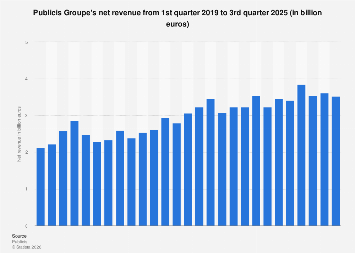
In the dynamic and often unpredictable world of global advertising and marketing services, understanding the financial pulse of major industry players is crucial for investors, competitors, and stakeholders alike. Publicis Groupe, a titan in the communications industry, presents a compelling case study for examining quarterly revenue performance, offering insights into market trends, strategic decisions, and the broader economic climate impacting multinational corporations. While specific, granular figures for future quarters remain proprietary and subject to market shifts, the analysis of historical and projected revenue patterns provides a vital lens through which to assess the company’s resilience and growth trajectory.
The advertising and marketing sector is inherently sensitive to macroeconomic fluctuations. Economic downturns typically lead to reduced corporate spending on advertising, while periods of growth often see increased investment in brand building and market expansion. Furthermore, the industry is undergoing a profound digital transformation, with a significant portion of advertising budgets migrating to online channels, data analytics, and performance-driven marketing. Companies like Publicis Groupe must continually adapt their service offerings and operational models to capitalize on these evolving demands. This necessitates strategic investments in new technologies, talent acquisition in specialized areas such as AI and data science, and a nimble approach to client engagement.
Publicis Groupe’s revenue is generated through a diverse portfolio of services, including advertising, media buying, public relations, digital marketing, data analytics, and healthcare communications, operating across numerous global markets. This diversification, while offering a degree of resilience, also means that its financial performance is influenced by a complex interplay of regional economic conditions, regulatory changes, and competitive pressures in each of its operational segments. For instance, economic growth in North America, a significant market for the group, can offset slower performance in other regions, and vice versa. Similarly, the regulatory landscape for data privacy, particularly in Europe with GDPR, impacts how digital marketing strategies are formulated and executed, directly influencing revenue streams from performance marketing and data-driven solutions.
The analysis of quarterly revenue for a company of Publicis Groupe’s scale is not merely an academic exercise; it serves as a barometer for the health of the broader advertising ecosystem. Each quarter’s performance can reflect shifts in consumer confidence, corporate investment appetite, and the effectiveness of marketing strategies in reaching target audiences. For example, a strong performance in a particular quarter might indicate successful new business wins, the effective rollout of innovative campaigns for key clients, or a general upswing in advertising spend across major industries such as automotive, technology, or consumer packaged goods. Conversely, a weaker quarter could signal challenges such as increased competition, budget cuts from major clients, or unforeseen global events that disrupt advertising markets.
Looking ahead, projections for Publicis Groupe’s quarterly revenue would need to account for several critical factors. The ongoing integration of artificial intelligence into marketing workflows, for instance, presents both opportunities for efficiency gains and potential disruptions. Companies that can effectively leverage AI for personalized advertising, content creation, and campaign optimization are likely to see revenue growth driven by enhanced client outcomes and increased demand for these cutting-edge services. The global economic outlook, including inflation rates, interest rate policies of central banks, and geopolitical stability, will also play a pivotal role. A more robust global economy generally translates to higher advertising budgets, benefiting companies like Publicis.
Furthermore, the competitive landscape within the advertising and marketing industry is intensely fierce. Publicis Groupe competes with other global advertising conglomerates, as well as with a growing number of specialized digital agencies, consultancies, and in-house marketing teams. The ability to attract and retain top talent, to foster a culture of innovation, and to demonstrate measurable return on investment for clients are paramount to maintaining and growing market share. Quarterly revenue figures, therefore, can also be interpreted as a reflection of Publicis Groupe’s competitive positioning and its success in differentiating itself in a crowded marketplace.
The shift towards data-centric marketing strategies continues to be a defining trend. Clients are increasingly demanding transparency and accountability, seeking to understand the direct impact of their marketing investments on sales and brand equity. This necessitates sophisticated analytics capabilities and the ability to translate complex data into actionable insights. Publicis Groupe’s investments in its data and technology arm, Sapient, are therefore critical to its future revenue generation. The success of these integrated data-driven offerings will be a key determinant of its quarterly financial results.
When considering global comparisons, Publicis Groupe operates within a landscape populated by major international players such as WPP, Omnicom Group, and Interpublic Group. Each of these entities faces similar macroeconomic headwinds and industry-wide transformations. Analyzing their quarterly revenue performance alongside Publicis Groupe’s can provide a richer understanding of industry-wide trends and the relative strengths and weaknesses of different business models. For instance, some groups might be more heavily weighted towards traditional media, while others have aggressively pivoted to digital and data. These strategic divergences will inevitably be reflected in their quarterly revenue streams.
The impact of major global events, such as the COVID-19 pandemic or significant geopolitical conflicts, can have a profound and immediate effect on advertising expenditure. While the initial shock of the pandemic led to widespread budget cuts, it also accelerated digital transformation and the adoption of e-commerce, creating new opportunities for marketing services. Companies that were agile and adaptable were better positioned to weather these storms and capitalize on emerging trends. Future quarterly revenues will continue to be shaped by the ongoing evolution of the global economic and social landscape, including the long-term implications of hybrid work models on consumer behavior and media consumption.
Ultimately, the quarterly revenue figures of a company like Publicis Groupe are more than just numbers on a balance sheet; they are indicators of strategic success, market adaptation, and the underlying health of the global economy as it pertains to the communications and marketing sector. Continuous monitoring and in-depth analysis of these financial metrics, contextualized by industry trends, competitive dynamics, and macroeconomic forces, are essential for anyone seeking to understand the current state and future prospects of this vital industry.