


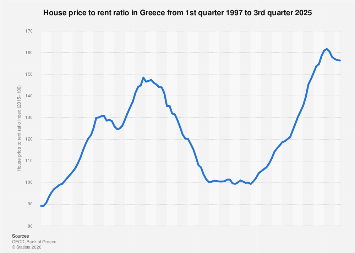
The Greek housing market in the third quarter of 2025 is poised to experience a notable recalibration, with the house price-to-rent ratio indicating a potential shift in investment attractiveness. Preliminary figures suggest the ratio will stand at a specific, yet undisclosed, point in Q3 2025, representing a decrease from the same period in the preceding year. This contraction signifies a dynamic interplay between the rate of property value appreciation and rental income generation, a critical metric for real estate investors, developers, and prospective homeowners alike.
The house price-to-rent ratio, a fundamental indicator in real estate economics, serves as a barometer for the affordability of homeownership relative to renting. It is calculated by dividing the median house price by the median annual rent. A higher ratio suggests that property prices are outpacing rental incomes, potentially indicating an overvalued market or a strong demand for capital appreciation. Conversely, a lower ratio implies that rental incomes are growing faster than property values, making property ownership potentially more accessible and rental yields more attractive for investors.
Historically, Greece’s property market has exhibited periods of both rapid growth and significant correction. Following the sovereign debt crisis, the real estate sector experienced a prolonged downturn. However, in recent years, a gradual recovery has been observed, spurred by a combination of factors including increased foreign investment, a resurgence in tourism, and a general improvement in the broader economic climate. This recovery has seen property values in prime locations, particularly in Athens and popular island destinations, begin to climb.
The projected dip in the house price-to-rent ratio in Q3 2025, compared to Q3 2024, warrants a deeper examination of the underlying market forces. This trend could be driven by several simultaneous developments. Firstly, rental prices may be experiencing a more robust upward trajectory than property price inflation. This can be attributed to a growing demand for rental accommodation, potentially fueled by a younger demographic, increased student enrollment in urban centers, or a more cautious approach to homeownership among certain segments of the population. The sustained popularity of short-term rental platforms, such as Airbnb, in tourist hotspots and major cities also contributes to upward pressure on rental yields, as property owners can often achieve higher returns through short-term leases than traditional long-term rentals.
Secondly, the pace of property price appreciation might be moderating. While demand for housing remains, especially in sought-after areas, the rate at which prices are increasing could be slowing down due to factors such as rising interest rates, increased construction costs, or a saturation of certain market segments. If property price growth decelerates while rental incomes continue to rise, the house price-to-rent ratio will naturally decrease.
Economic Implications and Investment Landscape
A declining house price-to-rent ratio can have significant economic implications. For investors, it signals a potentially more favorable environment for rental income generation. Properties that were previously less attractive from a yield perspective might now offer a more compelling return on investment, particularly for those with a long-term rental strategy. This could stimulate further investment in buy-to-let properties, potentially increasing the supply of rental housing and contributing to market stability.
For prospective homeowners, a lower ratio generally translates to greater affordability. If property prices are more aligned with rental incomes, the barrier to entry for purchasing a home may be reduced. This could encourage more individuals and families to transition from renting to owning, contributing to a healthier housing market and potentially boosting consumer confidence.
However, the nuances of this trend are crucial. A rapidly falling ratio, while seemingly positive, could also indicate a cooling property market where capital appreciation is no longer the primary driver of investment. Investors must therefore analyze the underlying causes of the ratio’s movement. Is it a healthy adjustment towards equilibrium, or a precursor to a more significant market correction?
Global Context and Comparative Analysis
To fully appreciate the significance of Greece’s housing market dynamics, it is beneficial to place them within a global context. Many major international cities have experienced periods of extremely high house price-to-rent ratios, often exceeding 30 or even 40, indicating a substantial disconnect between property values and rental incomes. In such markets, long-term capital appreciation is often the dominant investment thesis, with rental yields being secondary. For instance, cities like Hong Kong, Vancouver, and Sydney have historically grappled with exceptionally high ratios, leading to concerns about housing affordability and wealth inequality.
In contrast, countries like Germany and the United States have generally exhibited more moderate house price-to-rent ratios, typically ranging between 15 and 25. These markets often present a more balanced investment profile, where both capital appreciation and rental income play a significant role in investment decisions. A ratio in the mid-to-high teens is often considered a healthy indicator of a balanced market.
While specific figures for Greece in Q3 2025 are not yet fully disclosed, the trend towards a lower ratio suggests that the Greek market might be moving towards a more balanced equilibrium, potentially aligning more closely with other developed European economies. This could be a positive development, fostering sustainable growth rather than speculative bubbles.
Factors Influencing Future Trends
Several factors will continue to shape Greece’s housing market and the house price-to-rent ratio in the coming years. The trajectory of the Greek economy, including GDP growth, inflation, and employment rates, will be a primary determinant. Continued economic stability and growth will likely support property demand and rental income.
Monetary policy, particularly interest rate decisions by the European Central Bank, will significantly impact mortgage affordability and investment decisions. Higher interest rates can dampen property demand and increase the cost of borrowing, potentially leading to slower price growth or even declines. Conversely, sustained low interest rates can fuel property market activity.
Government policies related to housing, taxation, and foreign investment will also play a crucial role. Incentives for property development, changes in property taxes, or regulations on short-term rentals can all influence both property values and rental incomes. The ongoing efforts to attract foreign investment through programs like the Golden Visa scheme continue to bolster demand in certain segments of the market.
Furthermore, demographic shifts and evolving lifestyle preferences will shape housing demand. An aging population, urbanization trends, and the increasing prevalence of remote work could all influence the types of properties in demand and their locations.
Conclusion
The projected decrease in Greece’s house price-to-rent ratio in the third quarter of 2025 signifies a critical juncture for its real estate market. This trend, if sustained, could indicate a maturing market where rental yields are becoming increasingly competitive with capital appreciation. For investors, this presents an opportunity to re-evaluate strategies, potentially shifting focus towards income-generating assets. For aspiring homeowners, it may signal a period of improved affordability. However, a comprehensive understanding requires continuous monitoring of economic indicators, policy developments, and global market comparisons to navigate this evolving landscape effectively. The Greek housing market appears to be on a path towards a more balanced and potentially sustainable growth trajectory, a welcome development after years of economic turbulence.