


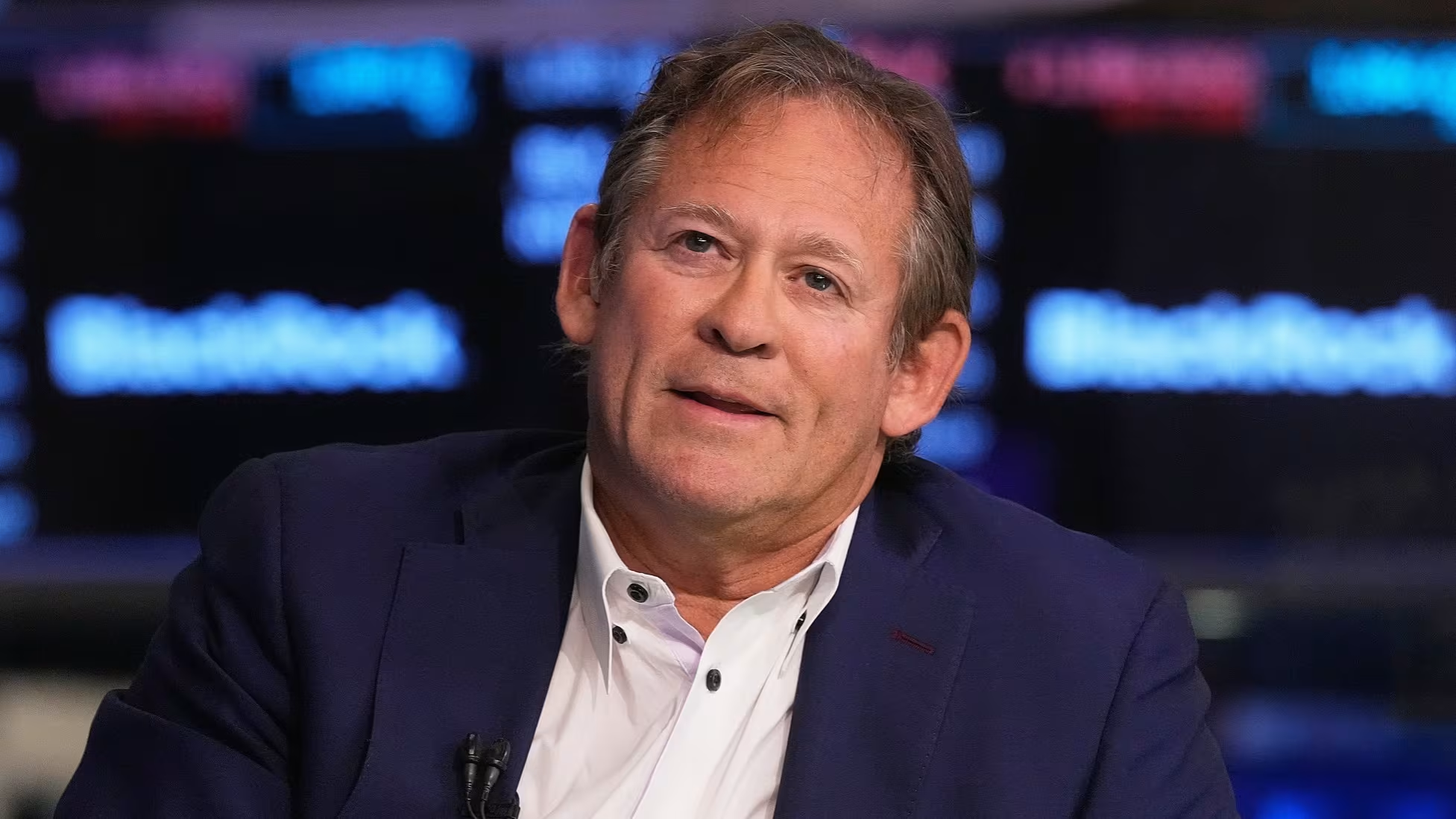
The corridors of power in Washington D.C. and the high-frequency trading hubs of Manhattan are increasingly converging on a single name as the potential successor to Jerome Powell: Rick Rieder. As the Chief Investment Officer of Global Fixed Income at BlackRock, the world’s largest asset manager, Rieder has long been a titan of the bond markets. However, his recent emergence as a frontrunner to lead the Federal Reserve marks a significant shift in the traditional profile of a central bank chief. Should he be nominated and confirmed, it would represent a transition from the legal and academic backgrounds that have dominated the Fed’s leadership for decades toward a more pragmatic, market-oriented stewardship of the American economy.
The speculation surrounding Rieder comes at a critical juncture for the U.S. economy. Jerome Powell’s term as Chair is set to expire in May 2026, and the political machinery of the next administration is already beginning to vet candidates who can navigate a landscape defined by post-pandemic volatility, persistent fiscal deficits, and the delicate "soft landing" of the labor market. While previous chairs like Ben Bernanke and Janet Yellen were celebrated for their academic rigor, and Powell for his legal and private equity background, Rieder offers the perspective of a practitioner who has spent decades managing trillions of dollars in real-time market fluctuations.
At BlackRock, Rieder oversees approximately $2.7 trillion in assets, a portfolio that necessitates a granular understanding of global capital flows, interest rate sensitivities, and the psychological underpinnings of investor behavior. His proponents argue that this "market-first" perspective is exactly what the Federal Reserve needs as it attempts to shrink a $7 trillion balance sheet and manage the long-term implications of the "higher for longer" interest rate environment. Rieder’s philosophy often centers on the concept of "data-dependency," but with a nuance that includes real-time financial conditions indices rather than just lagging economic indicators like the Consumer Price Index (CPI).
The transition from a market practitioner to a central banker is not without precedent, but it remains rare in the modern era. Historically, central banks have preferred the perceived neutrality of academia or the regulatory focus of the legal profession. However, the complexity of modern financial instruments and the speed at which monetary policy transmits through global markets have led some economists to suggest that a "market whisperer" might be better equipped to avoid the policy errors of the past. Rieder’s ability to communicate complex economic shifts in accessible terms—a trait he has honed through years of media appearances and investor letters—is seen as a vital asset for a Fed Chair who must manage the expectations of both Wall Street and Main Street.
However, the prospect of a BlackRock executive taking the helm of the world’s most powerful central bank is already drawing scrutiny. Critics point to the potential for "regulatory capture," questioning whether an individual from the pinnacle of the asset management industry can impartially regulate the very institutions that were once his peers or clients. The Federal Reserve serves not only as the setter of interest rates but also as the primary supervisor of the nation’s largest banks. Rieder’s appointment would likely face a rigorous confirmation process in the Senate, where populist voices from both ends of the political spectrum have expressed skepticism regarding the influence of "mega-firms" like BlackRock on public policy.
From an economic standpoint, a Rieder-led Federal Reserve would likely emphasize transparency and a more dynamic approach to the neutral rate—the theoretical interest rate that neither stimulates nor restricts economic growth. Rieder has frequently argued that the structural components of the U.S. economy, including technological advancements and demographic shifts, have fundamentally altered the relationship between inflation and employment. His leadership could signal a move away from the rigid adherence to the Phillips Curve—a traditional economic model suggesting a trade-off between unemployment and inflation—which many market participants believe has become less predictive in the digital age.
The global implications of this leadership race are profound. The Federal Reserve acts as the de facto central bank for the world, with the U.S. dollar serving as the primary reserve currency. International markets closely monitor the Fed’s "dot plot" and policy statements for cues on global liquidity. A chair with Rieder’s deep understanding of international capital markets could potentially foster better coordination with other major central banks, such as the European Central Bank (ECB) and the Bank of Japan (BoJ). This is particularly relevant as the world grapples with the "fragmentation" of global trade and the weaponization of financial systems in geopolitical conflicts.
In comparison to other potential candidates, such as former Fed Governor Kevin Warsh or hedge fund manager Scott Bessent, Rieder is often viewed as a more "institutional" choice despite his private-sector roots. While some candidates are seen as more ideologically aligned with specific political factions, Rieder has largely maintained a reputation for being a technocrat whose primary allegiance is to data and market stability. This perceived pragmatism could make him a more palatable choice for a divided Congress, provided he can successfully distance himself from the political controversies that sometimes surround BlackRock’s corporate governance and ESG (Environmental, Social, and Governance) initiatives.
The current economic backdrop adds a layer of urgency to the succession debate. While inflation has cooled from its 2022 peaks, the path back to the Fed’s 2% target remains uneven. Furthermore, the massive expansion of the federal debt—now exceeding $34 trillion—has raised concerns about "fiscal dominance," a scenario where the Fed’s ability to raise rates is constrained by the government’s cost of servicing its debt. Rieder has been vocal about the necessity of fiscal discipline, often noting that monetary policy cannot be the sole engine of economic stability. As Chair, he would be tasked with maintaining the Fed’s independence while navigating the intense political pressure that invariably accompanies periods of high government spending.
Market analysts are also weighing how a Rieder appointment might affect the Fed’s communication strategy. Under Jerome Powell, the Fed has moved toward a "plain English" approach, yet markets still frequently struggle to interpret the nuances of the Federal Open Market Committee (FOMC) statements. Rieder’s experience in explaining market volatility to institutional clients could translate into a more precise, albeit more technical, communication style. This could reduce the "taper tantrums" and sudden market shocks that occur when there is a disconnect between the Fed’s intentions and the market’s perceptions.
As the race to chair the Federal Reserve intensifies, the momentum behind Rick Rieder reflects a broader desire for a "practitioner’s touch" at the center of global finance. Whether he can navigate the political gauntlet of Washington remains to be seen, but his candidacy has already shifted the conversation about what qualities are most essential for the next steward of the American economy. The stakes could not be higher; the next Fed Chair will not only inherit the task of price stability but will also be the primary architect of the financial system’s resilience in an era of unprecedented technological and geopolitical change.
Ultimately, the choice of the next Fed Chair will be a statement of the nation’s economic priorities. By elevating a figure like Rieder, the administration would be signaling a commitment to market-driven intelligence and a departure from the purely theoretical models that have occasionally led to delayed policy responses. As the 2026 deadline approaches, the financial world will be watching closely to see if the man who currently manages the world’s bonds will soon be the man who manages the world’s money.