


The volume of gasoline consumed by passenger cars in France has undergone a notable transformation over the past two decades, reflecting a complex interplay of economic factors, evolving consumer behavior, and increasingly, environmental policy shifts. Data spanning from 2004 to 2023 reveals a dynamic trend, marked by an initial period of high consumption, a subsequent decline, a period of recovery, and a significant disruption driven by global events.
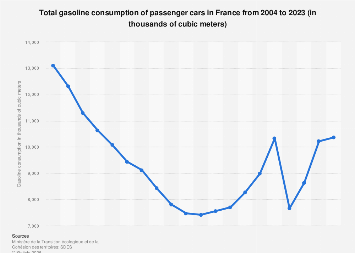
In the initial years of the observed period, specifically in 2004, French passenger cars consumed a substantial 13,103 thousand cubic meters of gasoline. This figure represented a peak in the early part of the data series, suggesting a strong reliance on internal combustion engine vehicles and a robust demand for personal mobility fueled by gasoline. The subsequent years saw a gradual but consistent downward trend. By 2008, consumption had decreased to 10,076 thousand cubic meters, a decline of over 3 million cubic meters from the 2004 high. This reduction can be partly attributed to rising fuel prices, increasing fuel efficiency standards in new vehicle models, and perhaps a nascent awareness of environmental impact.
The global financial crisis of 2008 and its lingering effects likely played a role in tempering discretionary spending, including on personal transportation. The downward trajectory continued through the early 2010s, reaching its lowest point in 2014 with 7,416 thousand cubic meters consumed. This represented a significant contraction from the 2004 levels, signaling a potential shift in how French households approached their transportation needs. Factors contributing to this low point could include sustained high fuel prices, increased adoption of smaller, more fuel-efficient vehicles, and a greater propensity for public transport or car-sharing in urban areas.
However, the period from 2015 to 2019 witnessed a discernible rebound in gasoline consumption. From the 2014 trough, usage climbed steadily, reaching 10,330 thousand cubic meters in 2019. This recovery suggests a renewed increase in personal vehicle usage, potentially linked to economic improvements, a stabilization or decrease in fuel prices for periods, and perhaps a resurgence in demand for larger or less fuel-efficient vehicles. The 2019 figure approached the consumption levels seen in the mid-2000s, indicating that the earlier decline was not a permanent structural shift but rather a phase influenced by specific economic and market conditions.
The year 2020 marked a dramatic and unprecedented interruption to this trend. The onset of the COVID-19 pandemic and the imposition of widespread lockdowns and travel restrictions across France brought a sharp halt to much of the nation’s vehicular traffic. Consequently, gasoline consumption by passenger cars plummeted to 7,658 thousand cubic meters in 2020. This represented an immediate and substantial drop, underscoring the direct correlation between mobility restrictions and fuel demand. The impact was felt globally, with many countries experiencing similar declines in transportation fuel consumption.
The recovery in 2021, with consumption rising to 8,636 thousand cubic meters, signaled a gradual return to pre-pandemic mobility patterns as restrictions eased. This rebound continued robustly in 2022, with consumption reaching 10,218 thousand cubic meters, and further in 2023, to 10,365 thousand cubic meters. The 2023 figure indicates a near-complete restoration of gasoline consumption levels to those seen in the peak year of 2019, suggesting that the pandemic-induced dip was largely a temporary anomaly rather than a fundamental change in the long-term demand for gasoline-powered vehicles.
This near-recovery to 2019 levels, however, occurs against a backdrop of increasingly ambitious climate targets and a burgeoning electric vehicle (EV) market. While gasoline consumption has rebounded, the underlying structure of the French automotive market is undergoing a profound transformation. Government incentives for EV purchases, coupled with expanding charging infrastructure and a growing range of electric models, are steadily increasing the market share of zero-emission vehicles.
The economic implications of these trends are multifaceted. For the oil and gas industry, the sustained, albeit fluctuating, demand for gasoline in France represents a significant market. However, the long-term outlook is shaped by the accelerating transition to cleaner energy sources. Companies heavily invested in gasoline production and distribution must adapt to this evolving landscape by diversifying their portfolios or focusing on more sustainable energy solutions.
For consumers, the fluctuating gasoline prices, combined with the increasing availability and decreasing total cost of ownership of EVs, are influencing purchasing decisions. While the immediate rebound in gasoline consumption suggests that internal combustion engine vehicles remain dominant, the growing momentum of the EV transition indicates that this dominance is likely to diminish in the coming years. This shift has implications for household budgets, with the higher upfront cost of EVs offset by lower running costs, particularly in a context of volatile energy prices.
The French government’s energy policy plays a crucial role in shaping this trajectory. Ambitious targets for reducing greenhouse gas emissions necessitate a phasing out of fossil fuel-powered vehicles. This is being achieved through a combination of regulations, financial incentives for EV adoption, and investment in public transportation. The success of these policies will ultimately determine the pace at which gasoline consumption declines in the long term.
Globally, France’s gasoline consumption trends offer a case study in the complexities of energy transitions. While some nations may see a more rapid decline in gasoline use due to aggressive policy interventions or unique market dynamics, France’s experience highlights the inertia of established automotive infrastructure and consumer preferences. The rebound in 2022 and 2023, despite growing environmental concerns, underscores that the transition away from gasoline is a gradual process, influenced by economic conditions, technological advancements, and the pace of policy implementation.
Looking ahead, the future of gasoline consumption in France will likely be characterized by a slow but steady decline. The recent resurgence in demand may prove to be a temporary plateau before a more pronounced downward trend takes hold as EV adoption accelerates and regulatory pressures intensify. The interplay between economic recovery, consumer choices, and governmental climate strategies will continue to define the evolving landscape of automotive fuel consumption in the nation. The data from 2004 to 2023 provides a critical historical lens, illustrating that while immediate disruptions can occur, the long-term trajectory is increasingly pointed towards decarbonization.