
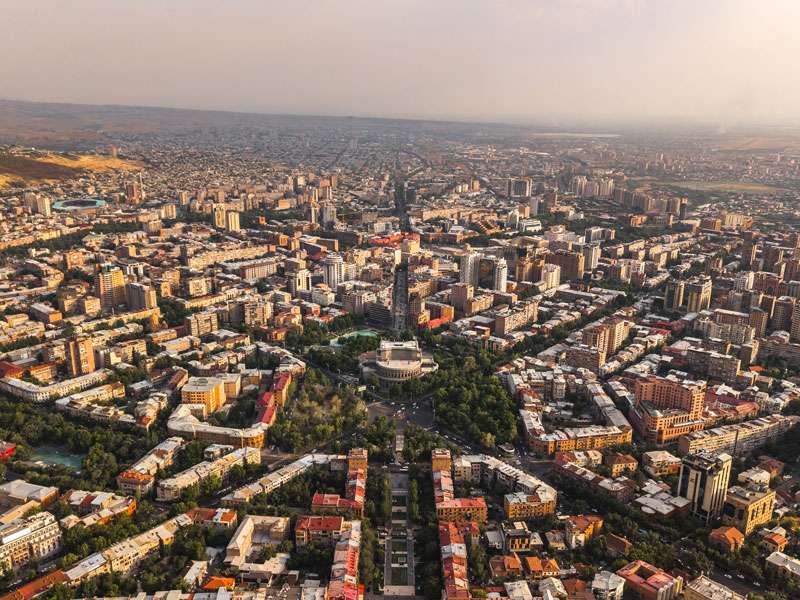
The strategic landscape of the South Caucasus is undergoing a subtle yet significant transformation, with landlocked Armenia increasingly pivoting towards innovation as a cornerstone of its future economic and geopolitical standing. For decades, this nation of fewer than three million people has been inextricably linked to Russia, its primary security guarantor and economic partner. However, a burgeoning technology sector, fueled by both domestic ambition and burgeoning international investment, is creating a compelling narrative of self-determination and a deliberate effort to chart a course independent of Moscow’s long-standing sphere of influence. This digital renaissance is not merely an economic pursuit; it is a calculated strategy to enhance national sovereignty and forge deeper connections with the global economy.
Samvel Khachikyan’s professional trajectory exemplifies this national evolution. A young individual who, after a formative military service during the 2020 Nagorno-Karabakh War, transitioned into the venture capital world, now spearheads SmartGate, a firm actively bridging Armenian tech talent with Silicon Valley and Los Angeles. His journey, marked by a profound desire to learn and contribute, mirrors the broader national aspiration to leverage intellectual capital for economic advancement and international recognition. The conflict in 2020, which saw Azerbaijan reclaim significant territories with the loss of thousands of lives, underscored Armenia’s precarious security situation and highlighted the limitations of relying solely on traditional alliances for regional stability. This experience, for many, including Khachikyan, instilled a renewed sense of purpose and a drive to build a more resilient future.
Historically, Armenia’s alignment with Russia was a pragmatic response to regional security threats, particularly from Turkey and Azerbaijan. As Natalie Sabanadze, a Senior Research Fellow at Chatham House, explains, "Historically, the greatest threat to Armenia in the region came from Turkey. Later, as a result of the Karabakh conflict, Azerbaijan also became a threat. To minimise the risks, Armenia chose to maintain its alliance with Russia after the collapse of the Soviet Union." This created a geopolitical dichotomy in the Caucasus, with one axis comprising Russia, Armenia, and Iran, and another aligned with the West, including Turkey, Georgia, and Azerbaijan. However, under Prime Minister Nikol Pashinyan, there’s a discernible shift away from this traditional balancing act towards a more outward-looking policy, seeking to reduce dependency on Moscow. This realignment, exemplified by diplomatic overtures towards Western partners, presents a formidable challenge in attracting significant investment amidst ongoing regional instability.
The technology sector has emerged as Armenia’s strategic niche, offering a pathway to greater political and economic independence. The nation is actively cultivating its digital ecosystem, a quiet transformation that is now attracting global attention. A landmark project, slated for completion in 2026, involves US tech giant Nvidia establishing a substantial AI data center. This $500 million investment, set to deploy thousands of Nvidia Blackwell GPUs and requiring over 100 megawatts of capacity, represents one of the region’s most significant technological undertakings. Mkhitar Hayrapetyan, Armenia’s Minister of High-Tech Industry, views this initiative as a crucial step in positioning Armenia as a regional technology hub, emphasizing that the ambition is as much geopolitical as it is technological. This focus on innovation is particularly strategic for a nation with limited natural resources, aiming to create value through intellectual prowess and digital infrastructure.
The success of this strategy is often benchmarked against other nations that have leveraged technology for development. Estonia, for instance, following its independence from the Soviet Union, strategically invested in a digital economy and robust technological infrastructure, transforming itself into one of the world’s most advanced digital societies. Armenia appears poised to follow a similar path, recognizing that its intellectual capital can be a potent engine for growth.
The underlying strength of Armenia’s tech push, according to Khachikyan, lies in its people. "People started building tech start-ups without any support from inside the country," he notes, highlighting a grassroots entrepreneurial spirit that recognized the potential for Armenia to become a regional leader. This burgeoning ecosystem is now receiving unprecedented attention from both the government and the public, recognizing the nation’s inherent intellectual capacity to compete on a global scale.
Concrete examples of this success are already evident. ServiceTitan, an Armenian-founded cloud-based software company for tradespeople, made history by becoming the first Armenian tech firm to list on the Nasdaq stock exchange, achieving a valuation exceeding $10 billion. Founded in 2012 by Armenian entrepreneurs Ara Mahdessian and Vahe Kuzoyan in California, the company has become a leader in its field. SmartGate VC, Khachikyan’s firm, is another testament to Armenian innovation, investing in cutting-edge technologies like artificial intelligence and brain-computer interfaces. Their early investment in AI, predating the current hype, demonstrates a deep understanding of foundational technologies. Beyond investment, SmartGate actively nurtures the ecosystem through initiatives like the Armenia Startup Academy, founded in 2018 to equip aspiring entrepreneurs with the knowledge and resources to build successful ventures.
The Armenian diaspora, a vast and globally dispersed community residing in over 100 countries, plays an indispensable role in amplifying the nation’s influence and fostering international connections. "Armenia has always maintained strong connections with both the West and the East, largely thanks to its diaspora," observes Sabanadze. "The diaspora factor is very significant, as Armenia has a highly influential global community that closely follows developments in the country." This global network serves as a critical bridge, facilitating knowledge transfer, investment, and advocacy for Armenia on the international stage.
Despite the promising trajectory of its tech sector, Armenia faces significant challenges stemming from its proximity to Russia. The central question remains whether Russia will permit Armenia to fully integrate into the Western economic sphere and establish itself as a technology hub. While some analysts believe Russia’s capacity to impede this shift is diminished due to its extensive commitments in Ukraine, others, like Natia Seskuria, an Associate Fellow at the Royal United Services Institute (RUSI), caution that Moscow is increasingly employing hybrid warfare tactics. "Militarily, Russia’s resources are quite limited due to the enormous expenditures in Ukraine," she states, "However, if we look at other hybrid warfare methods in the region – not just in Armenia – Russia has become more active since the war in Ukraine began."
Seskuria further points to upcoming elections as a period of heightened vulnerability, noting that "Elections are a politically vulnerable moment. Russia often sees them as an opportunity to intervene and influence the outcome using its resources."
Nevertheless, Khachikyan remains optimistic about Armenia’s technological future. The growing international interest and substantial investments, exemplified by Nvidia’s project, are expected to provide Armenian researchers and engineers with access to advanced technologies and enhanced computing power. However, he stresses that true progress hinges on a fundamental prerequisite: peace. "If people feel safer – free from wars and conflicts – growth will be stronger," Khachikyan asserts. "Because the most fundamental requirement for developing any economy, or any field, is security." The ongoing pursuit of peace, therefore, is intrinsically linked to Armenia’s ability to realize its ambitions in the global technology arena.