


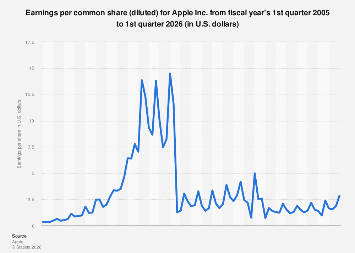
Apple Inc.’s earnings per common share (diluted) for the first quarter of its 2026 fiscal year reached a significant, albeit undisclosed, benchmark in U.S. dollars, underscoring the company’s continued robust financial performance in a dynamic global market. While specific figures for this recent period are proprietary, historical data reveals a compelling trajectory for the Cupertino-based technology behemoth, with earnings per share (EPS) exhibiting notable fluctuations over its nearly two-and-a-half-decade public history. This metric, a key indicator of profitability for shareholders, has seen its own historical extremes, dipping to approximately $0.07 in the second quarter of fiscal year 2005 and soaring to an impressive $2.26 in the first quarter of fiscal year 2012, illustrating the dramatic growth and evolving market conditions Apple has navigated.
Apple’s journey from its modest origins in a California garage to its current standing as the world’s most valuable brand is a narrative of relentless innovation and strategic market penetration. As the first publicly traded company to breach the $1 trillion market capitalization threshold, and subsequently the $2 trillion and $3 trillion marks, Apple has consistently delivered substantial returns to its investors. The company’s annual revenues, now consistently measured in the hundreds of billions of U.S. dollars, are a testament to its enduring appeal and its ability to redefine consumer electronics and digital services. From the revolutionary Mac computer and the ubiquitous iPod to the game-changing iPhone, Apple has repeatedly set new industry standards. Its expansion into software and services, including the vast ecosystem of the App Store, Apple Music, iCloud, and Apple Pay, has further diversified its revenue streams and solidified its market dominance, transforming it from a hardware manufacturer into a comprehensive technology and services provider.
The significance of Apple’s EPS performance in Q1 FY2026 cannot be viewed in isolation. It is intrinsically linked to broader macroeconomic trends, consumer spending patterns, and the competitive landscape of the global technology sector. For instance, the period surrounding Q1 FY2012, which saw a record high in EPS, coincided with a global economic recovery and a burgeoning demand for smartphones, a market Apple had largely pioneered with the iPhone. Conversely, periods of economic uncertainty or increased competition might lead to moderations in growth, reflected in EPS figures. Current analyses suggest that while the smartphone market remains a cornerstone of Apple’s business, the company’s strategic focus on services, wearables, and potentially new product categories like augmented reality devices, is designed to mitigate the cyclicality often associated with hardware sales and to unlock new avenues for sustained profitability.
Examining Apple’s EPS trends also offers insights into its operational efficiency and pricing power. A rising EPS, assuming a stable or growing share count, indicates that the company is generating more profit for each outstanding share of common stock. This can be achieved through increased revenue, improved cost management, or a combination of both. Apple’s ability to command premium pricing for its products, coupled with its sophisticated supply chain management and growing recurring revenue from its services segment, has been instrumental in driving its profitability. The company’s strong brand loyalty and ecosystem lock-in further contribute to its pricing power, allowing it to maintain healthy profit margins even in a highly competitive environment.
Globally, Apple’s financial health is a bellwether for the broader technology industry. Its earnings reports are scrutinized by analysts, investors, and policymakers worldwide, offering a glimpse into the health of consumer demand for high-end electronics and digital services. The company’s performance also impacts economies beyond its direct operations, through its vast network of suppliers, developers, and retailers. For example, the ongoing expansion of its services division not only boosts Apple’s own revenues but also creates opportunities for third-party developers who build applications and content for its platforms, fostering a significant digital economy.
Looking ahead, the Q1 FY2026 EPS figure will be a critical data point in assessing Apple’s strategic direction. Analysts will be keen to understand the drivers behind this performance. Was it primarily fueled by strong iPhone sales, a significant uptick in services revenue, the performance of its wearables division (including Apple Watch and AirPods), or perhaps the initial contributions from emerging product lines? The company’s ongoing investment in research and development, particularly in areas like artificial intelligence and potentially autonomous vehicles, signals a long-term vision that extends beyond its current product portfolio. These investments, while incurring significant upfront costs, are intended to secure future revenue streams and maintain Apple’s competitive edge, ultimately impacting its future EPS trajectory.
Furthermore, the global economic climate in FY2026 will play a crucial role. Factors such as inflation, interest rates, geopolitical stability, and consumer confidence in key markets like North America, Europe, and Asia will all influence Apple’s top-line revenue and its bottom-line profitability. The company’s ability to navigate potential supply chain disruptions, currency fluctuations, and evolving regulatory landscapes across different jurisdictions will be paramount. Apple’s diversification into services, which often have higher gross margins than hardware, provides a degree of resilience against these external shocks.
The historical EPS figures, from the relatively modest beginnings in FY2005 to the peaks seen in FY2012, illustrate a remarkable journey of exponential growth and strategic adaptation. The undisclosed Q1 FY2026 figure represents the latest chapter in this ongoing saga, a testament to Apple’s sustained relevance and its capacity to generate significant shareholder value. As the company continues to innovate and expand its offerings, its earnings per share will remain a central metric for understanding its financial performance and its enduring impact on the global economic landscape. The strategic decisions made today, concerning product development, market expansion, and operational efficiency, will undoubtedly shape the EPS figures for fiscal years to come, continuing the compelling narrative of one of the world’s most influential corporations.