


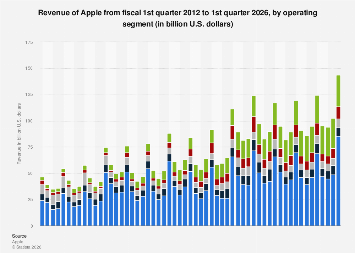
Apple’s financial performance in the first quarter of fiscal year 2026 underscores its continued dominance in the global technology landscape, with the company reporting substantial revenue figures across its diverse product and service portfolios. While the iPhone remains the undisputed titan of Apple’s revenue generation, a closer examination of the company’s quarterly segmentation reveals a sophisticated ecosystem where hardware, software, and services converge to drive sustained growth and robust financial health. As of the first quarter of FY2026, the iPhone alone contributed an estimated $45 billion to Apple’s coffers, a testament to its enduring appeal and market penetration.
Apple achieved a record-breaking total net sales of $383.3 billion in fiscal year 2025, a figure that speaks volumes about its operational efficiency, unparalleled brand loyalty, and relentless pursuit of product innovation. This consistent upward trajectory, experts suggest, is a direct consequence of Apple’s strategic approach, which emphasizes not just the introduction of novel devices and features but also the cultivation of a loyal customer base. The company’s history is punctuated by paradigm-shifting products, from the groundbreaking iPod that revolutionized digital music consumption to the ubiquitous iPhone that redefined mobile communication and computing. However, the evolution of technology, as exemplified by the increasing capabilities of smartphones to manage music libraries, ultimately led to a discernible decline in the sales of dedicated digital music players like the iPod, a clear indicator of market dynamics and Apple’s adaptability.
The Rise of the iPhone: A Revenue Powerhouse
Since its debut in 2007, the iPhone has steadily ascended to become the cornerstone of Apple’s financial success. In the first quarter of FY2026, iPhone sales revenue surged past the $45 billion mark. This significant revenue stream has had a profound and direct impact on its proportion of Apple’s total revenue. In early 2009, the iPhone accounted for a modest 20% of Apple’s overall revenue. By the first quarter of FY2026, this figure had dramatically increased to an estimated 60%, highlighting its critical role in the company’s financial architecture. This growth trajectory is not merely a reflection of unit sales but also of Apple’s premium pricing strategy and its ability to maintain a strong market share even in a highly competitive smartphone arena. The device’s continuous upgrades, integration with Apple’s expanding ecosystem, and the perceived value proposition it offers to consumers have been instrumental in this sustained market leadership.
Beyond the iPhone: Diversified Revenue Streams
While the iPhone commands significant attention, Apple’s revenue generation is far from monolithic. Other key product categories and its burgeoning services division play crucial roles in its financial performance. In the first quarter of FY2025, the combined revenue from the iPad tablet, Mac computers, and Apple’s comprehensive suite of customer services surpassed $35 billion. This demonstrates the significant market acceptance and sustained demand for Apple’s personal computing devices and its increasingly vital service offerings.
The "Wearables, Home and Accessories" segment, which includes popular products like the Apple Watch and AirPods, also represents a substantial and growing revenue stream. In the same first quarter of FY2025, this segment alone generated over $15 billion. This category’s rapid expansion is indicative of Apple’s successful diversification strategy, tapping into consumer demand for integrated lifestyle technology and further solidifying customer engagement with the Apple ecosystem. The increasing average selling prices (ASPs) within this segment, driven by premium product launches and feature enhancements, contribute significantly to its revenue growth.
The Services Segment: A Strategic Growth Engine
Apple’s Services division, encompassing the App Store, Apple Music, iCloud, AppleCare, Apple TV+, and other subscription-based offerings, has emerged as a critical growth engine, providing recurring revenue that is less susceptible to the cyclical nature of hardware sales. While specific Q1 FY2026 figures for services are not detailed in the provided data, the trend from FY2025 indicates its growing importance. The combined revenue from iPad, Mac, and Services in Q1 FY2025 exceeding $35 billion suggests a substantial contribution from the services segment alone, likely in the tens of billions of dollars. This segment’s profitability is particularly attractive, with generally higher margins compared to hardware. Apple’s strategy of bundling services with hardware, offering attractive subscription packages, and continuously expanding its service catalog is designed to deepen customer loyalty and create a sticky ecosystem that encourages repeat purchases and ongoing engagement. This recurring revenue model provides Apple with a more predictable financial outlook and insulates it to some extent from the inherent volatility of the consumer electronics market.
Market Context and Global Comparisons
Apple’s financial performance can be contextualized within the broader global technology market. While the smartphone market, led by the iPhone, continues to be a dominant force, growth rates are maturing in developed economies, necessitating diversification. The tablet and personal computer markets, while still substantial, face competition from a range of manufacturers. However, Apple’s ability to command premium pricing and foster intense brand loyalty sets it apart. Globally, Apple competes with a diverse array of tech giants, from Samsung in the mobile space to Microsoft and Google in operating systems and services. Its consistent ability to outperform many competitors in terms of revenue and profitability stems from its integrated hardware-software-services approach, a tightly controlled supply chain, and a marketing strategy that emphasizes premium quality and user experience.
Economic Impact and Future Outlook
Apple’s significant revenue generation has a profound ripple effect on the global economy. The company is a major employer, both directly and indirectly through its vast supply chain and retail network. Its sustained profitability fuels innovation, drives investment in research and development, and contributes significantly to tax revenues in the regions where it operates. The ongoing development and success of its product lines, particularly the iPhone and its expanding services, indicate a robust future. The company’s strategic investments in areas such as augmented reality, artificial intelligence, and automotive technology suggest a forward-looking approach aimed at securing its position as a technology leader for years to come. As Apple navigates the complexities of the global market, its diversified revenue streams and strong ecosystem are expected to remain key pillars of its continued financial success, making it a benchmark for operational excellence and strategic foresight in the technology sector. The data for fiscal year 2026, as it unfolds, will offer further insights into the sustained performance of its core segments and the impact of its strategic initiatives on its overall financial health.